Grok 4.7 vs GPT-6 Astra: Benchmark Results Show an Edge in Real-World Knowledge Work
Grok 4.7 beats GPT-6 Astra on key professional benchmarks, GDPval and AA Briefcase. Discover why this matters for real-world business AI.
The AI race is getting harder to follow by the week. New models are arriving with stronger reasoning, better coding abilities, longer context windows and increasingly capable AI agents.
But while benchmark scores can sometimes feel abstract, evaluations that test real-world professional work offer a more practical way to understand how these models perform.
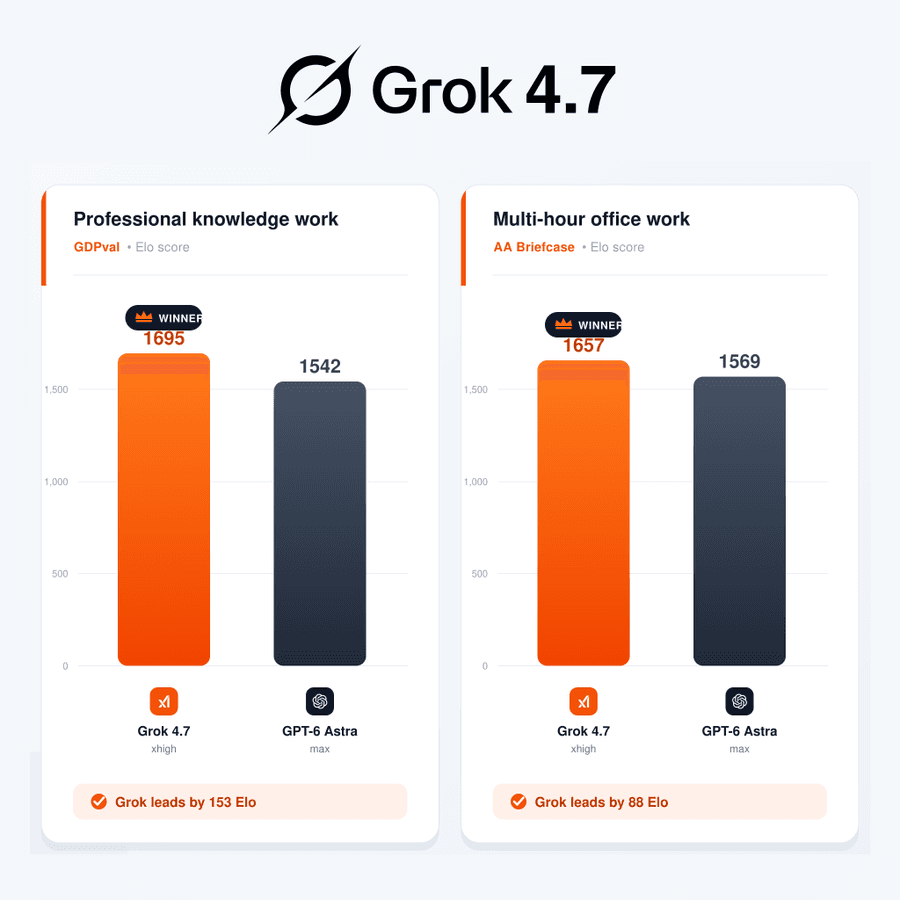
The latest results put Grok 4.7 ahead of GPT-6 Astra on two professional knowledge-work benchmarks: GDPval and AA Briefcase.
On GDPval, Grok 4.7 recorded an Elo score of 1,695, compared with 1,542 for GPT-6 Astra. On AA Briefcase, which focuses on longer, multi-step office and knowledge-work tasks, Grok 4.7 scored 1,657, while GPT-6 Astra scored 1,569.
That represents a difference of 153 Elo points on GDPval and 88 Elo points on AA Briefcase.
The results don't mean Grok 4.7 is automatically better at everything. AI model performance varies considerably depending on the task, benchmark, reasoning configuration and evaluation setup. But they do make Grok 4.7 particularly interesting for people looking at AI models for professional productivity, business workflows and long-running knowledge work.
Grok 4.7 vs GPT-6 Astra: The Numbers
Here's how the two models compare on the two benchmarks:
BenchmarkGrok 4.7GPT-6 AstraDifferenceGDPval1,695 Elo1,542 Elo+153AA Briefcase1,657 Elo1,569 Elo+88
The Grok 4.7 results were measured at xhigh reasoning effort, while the GPT-6 Astra figures were reported using maximum reasoning effort in the comparison.
That detail matters because reasoning settings can influence how much computation a model uses before producing its final answer.
What Is the GDPval Benchmark?
GDPval is designed to evaluate AI models on professional knowledge-work tasks rather than simply asking questions with straightforward answers.
The benchmark is intended to reflect the kind of work performed by professionals across areas such as analysis, research, documentation and other knowledge-intensive roles.
The scoring uses an Elo-style rating system, similar in concept to the ratings used in competitive games such as chess. A higher Elo score indicates stronger relative performance within the evaluated comparison.
Grok 4.7's 1,695 Elo score places it well above GPT-6 Astra's 1,542 in the reported comparison. It also represents a substantial improvement over Grok 4.6, which scored 1,605 on the same GDPval-AA evaluation.
Interestingly, Grok 4.7 is not at the very top of the GDPval leaderboard. Current Artificial Analysis results list Claude Fable 5.1 at 1,735 Elo, followed by Grok 4.7 at 1,695.
What Is AA Briefcase?
The second benchmark, AA Briefcase, focuses on agentic knowledge work and longer-running office tasks.
Instead of testing a model with a single short prompt, these evaluations are designed around realistic workflows that can require multiple steps and deliverables. Examples can include producing documents, spreadsheets, presentations and analytical work.
This makes AA Briefcase particularly interesting for businesses exploring AI agents that can do more than answer questions.
Grok 4.7 scored 1,657 Elo on AA Briefcase, compared with 1,569 for GPT-6 Astra.
Grok 4.7 also improved significantly over its predecessor. Grok 4.6 scored 1,546 in the same evaluation, meaning Grok 4.7 gained 111 Elo points.
However, Grok 4.7 does not lead the overall AA Briefcase leaderboard. Artificial Analysis currently lists Claude Fable 5.1 at 1,678 Elo and Claude Opus 5 at 1,673, ahead of Grok 4.7's 1,657.
What Do These Results Mean for Real-World AI Use?
The biggest takeaway is not simply that one model scored higher than another.
It is that AI models are becoming increasingly capable of handling complete professional workflows rather than isolated tasks.
For businesses, this distinction matters.
A model used as an AI assistant might be asked to summarize a document or write an email. An AI agent working inside a business environment may instead need to research information, analyze data, create a spreadsheet, prepare a presentation and produce a final report.
Those are very different workloads.
The AA Briefcase results are therefore particularly relevant to organizations exploring AI agents, workplace automation and enterprise AI.
Grok 4.7's strong performance suggests that it can be competitive when a task requires sustained reasoning and the production of practical work products.
Grok 4.7 Isn't Ahead on Every AI Benchmark
It's important not to take the GDPval and AA Briefcase results out of context.
Different AI benchmarks measure different abilities, and a model can perform extremely well in one area while trailing other models in another.
For example, Artificial Analysis' broader evaluation of Grok 4.7 gives it an Intelligence Index score of 46, while its Coding Agent Index score with Grok Build is 56. The same evaluation also reports strong improvements over Grok 4.6 in several coding and knowledge-work areas.
Meanwhile, other evaluations show different competitive positions for GPT-6 Astra and other frontier AI models.
This is why a single benchmark should not be treated as a definitive measure of overall AI capability.
Instead, benchmarks should be viewed as pieces of evidence that help explain where a model performs well.
Why the Grok 4.7 Results Matter
The bigger story behind Grok 4.7 is the continued shift toward agentic AI and practical knowledge work.
The AI industry is moving beyond models that simply generate text or answer questions. Companies increasingly want AI systems that can complete tasks, use tools, work with files, perform research and produce finished deliverables.
That makes long-horizon benchmarks such as AA Briefcase increasingly relevant.
Grok 4.7's 1,657 Elo score shows that xAI's latest model is competing seriously in this area, while its 1,695 GDPval score demonstrates strong performance on professional knowledge-work tasks.
Grok 4.7 vs GPT-6 Astra: Which One Is Better?
There isn't a single answer based on these results alone.
On the two benchmarks discussed here, Grok 4.7 records the higher scores. But that doesn't establish a universal winner across coding, research, reasoning, computer use, healthcare, mathematics or other AI workloads.
The more useful question for businesses and individual users is which model performs best for the specific tasks they need to complete.
Someone building an AI-powered coding workflow may care about a very different set of benchmarks from a company looking for an AI assistant that can create reports, analyze spreadsheets or automate office processes.
In other words, benchmark results are becoming less about finding one model that wins everything and more about understanding which AI model is best suited to a particular workflow.
The Future of AI Benchmarking
As frontier AI models become more capable, traditional question-and-answer benchmarks are only part of the picture.
The next generation of AI evaluations will increasingly need to measure whether models can actually complete useful work.
Can an AI agent research a complicated topic? Can it analyze a large dataset? Can it create a professional presentation? Can it work through several hours of tasks without losing track of the objective? And, perhaps most importantly, can the final output be trusted and used by a real person?
Benchmarks such as GDPval and AA Briefcase are moving in that direction.
For now, the latest results give Grok 4.7 a clear edge over GPT-6 Astra on the specific professional knowledge-work evaluations discussed here, with a 153-point advantage on GDPval and an 88-point advantage on AA Briefcase.
But the broader AI landscape remains highly competitive, and no two benchmarks can capture everything an advanced AI model is capable of doing.
As models continue to improve, the real competition may ultimately be less about who has the highest benchmark score—and more about which AI can reliably get useful work done in the real world.
Frequently Asked Questions
Is Grok 4.7 better than GPT-6 Astra?
Grok 4.7 scores higher than GPT-6 Astra on the reported GDPval and AA Briefcase evaluations. However, these two benchmarks do not measure every aspect of AI performance, so the results should not be interpreted as a universal comparison.
What is the GDPval benchmark?
GDPval is a professional knowledge-work benchmark designed to evaluate AI models on tasks that resemble economically valuable work performed by knowledge professionals. Results are reported using an Elo-style scoring system.
What is AA Briefcase?
AA Briefcase is an agentic knowledge-work benchmark focused on realistic, longer-running professional tasks. It evaluates a model's ability to complete multi-step workflows and produce useful deliverables.
What is Grok 4.7?
Grok 4.7 is xAI's latest frontier AI model, released in September 2026, with a strong focus on reasoning, coding, agentic workflows and professional knowledge work. Artificial Analysis reports significant improvements over Grok 4.6 on several of its evaluations.
Does Grok 4.7 outperform every other AI model?
No. The available benchmark results show that performance varies significantly by evaluation. For example, current AA Briefcase results place Claude Fable 5.1 and Claude Opus 5 ahead of Grok 4.7 on that leaderboard.