Gemini 4 Argon Is Now Available Worldwide: Google's New AI Model Targets Coding, Science and Complex Reasoning
Explore Google Gemini 4 Argon, its coding and science capabilities, 1M-token limit, API pricing, global availability, and how developers can access it.
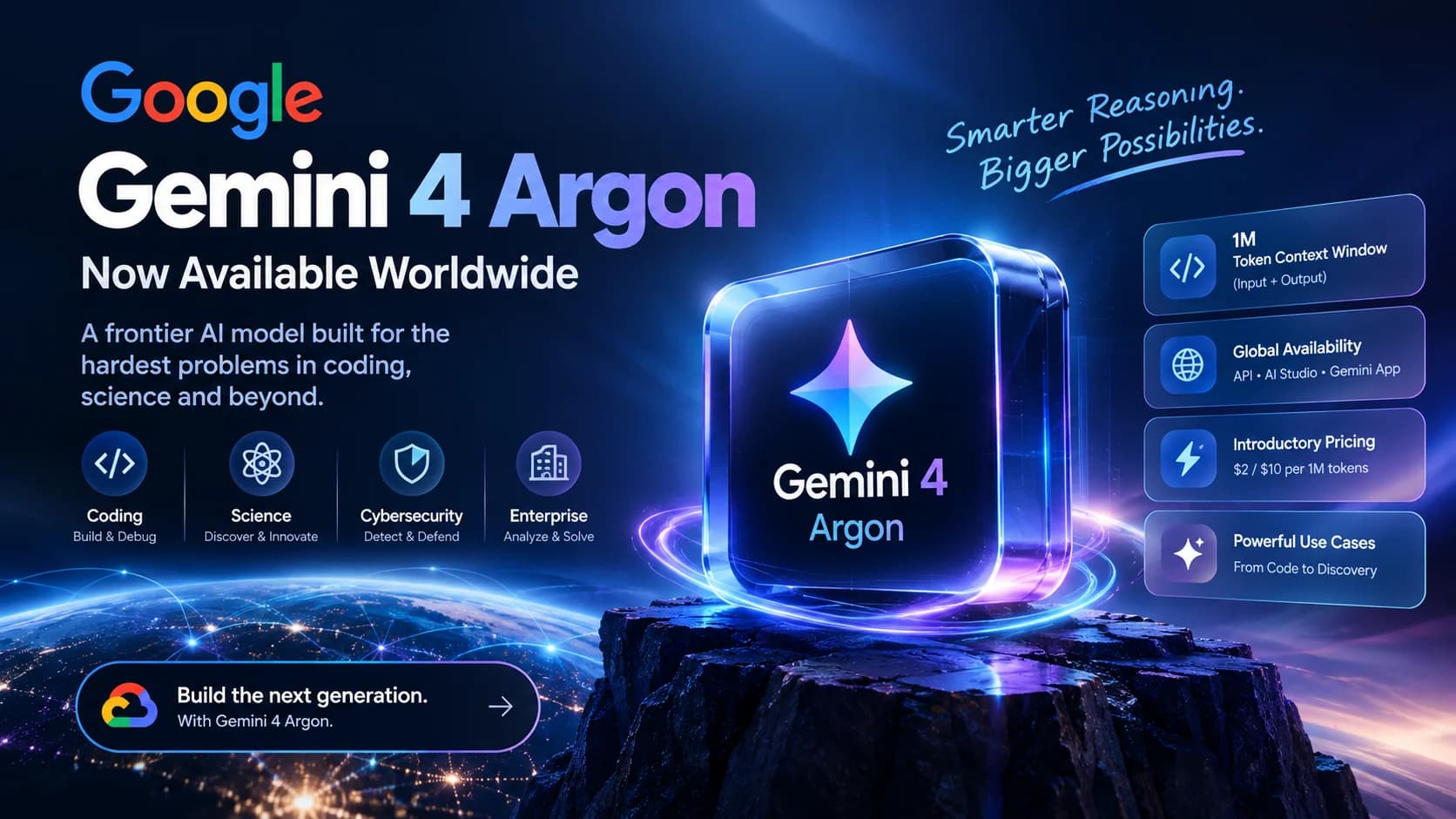
Google has officially launched Gemini 4 Argon, its latest frontier AI model designed to tackle demanding tasks in software engineering, scientific research, cybersecurity, and enterprise knowledge work.
Announced on October 13, 2026, Gemini 4 Argon is built for complex, multi-step workflows that require more than a quick answer. Google says the model can work across large codebases, analyze extensive documents, assist with scientific investigations, and support professional tasks involving legal research, financial analysis, and cybersecurity defense.
The release also brings the model to developers and paying subscribers worldwide, with access through the Gemini API, Google AI Studio, Google Antigravity, the Gemini app, and AI Mode in Search, depending on the user's plan and eligibility.
One of the headline features is a 1-million-token unified input-output limit through the Gemini API. Google has also introduced API pricing starting at $2 per million input tokens and $10 per million output tokens during the introductory period.
But what makes Gemini 4 Argon different, what can it actually do, and how can developers start using it?
What Is Google Gemini 4 Argon?
Gemini 4 Argon is Google's latest frontier AI model, developed to handle complex real-world tasks that require sustained reasoning, precision, and multiple steps.
Traditional chatbot interactions often involve asking a question and receiving an answer. Argon is designed to support more involved workflows, including examining a large software project, proposing architectural changes, testing possible solutions, and helping developers implement them.
Its intended use cases extend beyond programming. Google highlights applications in finance, legal work, cybersecurity, mathematics, scientific research, and robotics.
According to Google's announcement, Argon combines advanced reasoning with visual understanding, broader domain knowledge, and improved writing capabilities. The company also says the model communicates more directly and avoids unnecessary repetition compared with its previous Gemini models.
These are Google's stated capabilities, and real-world performance will depend on the task, available tools, model configuration, and quality of the surrounding workflow.
The central idea behind Gemini 4 Argon is straightforward: make AI more useful for difficult, extended tasks rather than focusing exclusively on short conversational responses.
Gemini 4 Argon Benchmark Performance: A New Frontier for AI?
Google says Gemini 4 Argon ranks first on the Vals Index, an evaluation that measures performance across economically significant professional tasks, including finance, coding, legal work, and tax-related activities.
The Vals Index is one indicator of how a model performs across selected professional evaluations. It should not be interpreted as proof that Argon is the best model for every task or that it will outperform every competitor in every environment.
For developers and businesses, the more interesting question is whether the model can translate benchmark performance into practical improvements.
Google has highlighted several examples from its own engineering teams and external research partners.
1. Software Engineering and Large Codebases
One of the most notable examples involves the Chromium project, the open-source foundation of Google Chrome and several other browsers.
Google says Argon helped its Chrome team refactor a legacy section of approximately six million lines within a broader Chromium codebase of around 40 million lines.
The work involved architectural changes across hundreds of files. According to Google, the team completed the effort in weeks rather than months.
The intended result includes improvements to how live webpages move between browser tabs, side panels, and floating windows, alongside the elimination of a category of browser crashes.
This example illustrates the kind of work Google wants Argon to handle: complex changes that span many files and require careful coordination rather than isolated code generation.
However, the reported result comes from Google's own engineering experience. It should not be taken as a guarantee that the model can independently refactor every large codebase with similar speed or reliability.
2. More Agentic Code Submissions and Fewer Rollbacks
Google also reports that engineers using Argon through its Antigravity development platform increased agentic code submissions by more than 35%, while reducing code rollbacks by nearly one-third.
Agentic coding refers to workflows in which AI can perform multiple development steps, potentially including inspecting code, planning changes, editing files, and running checks through connected tools.
A higher volume of submissions is useful only when the changes are also reliable. Google's reported reduction in rollbacks is therefore an important part of its claim.
Even so, these figures describe Google's internal experience. Independent teams should evaluate the model using their own codebases, review processes, testing systems, and performance metrics before assuming they will see comparable results.
3. Optimizing Python Applications
Another example involves Google's open-source Agent Development Kit, or ADK, a framework for building AI agents.
Google says Argon helped the team reduce in-memory session preparation time by 40% during long sessions and improve cold-import performance by 21%.
The changes were made with the goal of improving framework performance without breaking existing applications.
Developers can inspect the related project and code changes here:
This example highlights a potentially valuable use of AI coding agents: performance engineering. Rather than merely generating new features, an AI system can help investigate bottlenecks and propose changes that improve existing software.
The quality of those changes still needs to be established through tests, profiling, code review, and reproducible measurements.
4. Faster Scientific Computing
Google also describes using Argon to optimize xTB, an open-source quantum chemistry package used to study molecular structures and support computational chemistry research.
According to Google, the work made molecular structure predictions up to 2.3 times faster and conformer searches up to 1.8 times faster.
The resulting changes were contributed to the project's official repository.
Explore the source code: xTB on GitHub
This is an important example because scientific computing often involves specialized software, complex mathematical methods, and performance-sensitive workloads.
If AI can help researchers optimize existing scientific tools, the benefits could extend beyond generating code to improving the speed of established research workflows.
Still, scientific software must be validated carefully. Faster execution is valuable only when the implementation preserves the required numerical behavior and scientific correctness.
A One-Million-Token Context Limit for Long-Running Tasks
One of Gemini 4 Argon's headline features is its 1-million-token unified input-output limit through the Gemini API.
A token is a unit of text or other content processed by a language model. Token counts do not correspond exactly to word counts, and the amount of material represented by a given token budget varies with the content.
A large token limit can be useful when a task requires extensive background information or a long sequence of interactions.
Potential applications include:
Analyzing large software repositories.
Reviewing long technical documents.
Comparing contracts and supporting legal materials.
Investigating large research collections.
Working with lengthy project histories.
Combining documentation, code, and supporting evidence in one workflow.
For example, a developer investigating a complex bug may need to examine code, configuration files, documentation, and test results together. A large context budget can reduce the need to repeatedly provide small fragments of that information.
However, context capacity is not the same as perfect recall. A model may still overlook details, make incorrect connections, or struggle to use every piece of information in an extensive input.
Developers should also account for the model's actual token usage, latency, API limits, and cost when building long-running workflows.
Gemini 4 Argon API Pricing: How Much Does It Cost?
Google launched Gemini 4 Argon with introductory API pricing intended to make the model accessible to developers and organizations evaluating its capabilities.
The published prices are:
Input tokens: $2 per million tokens.
Output tokens: $10 per million tokens.
Cached input tokens: 95% below the standard input-token price.
After the introductory period expires on November 30, 2026, Google's announced standard prices for the public-access model are scheduled to become $4 per million input tokens and $20 per million output tokens. <Cite refs={["turn922256view0"]} />
Example API cost calculation
Consider a hypothetical request that uses 100,000 input tokens and generates 20,000 output tokens.
At the introductory rates:
Input: 0.1 million × $2 = $0.20.
Output: 0.02 million × $10 = $0.20.
Estimated total: $0.40.
At the announced standard rates:
Input: 0.1 million × $4 = $0.40.
Output: 0.02 million × $20 = $0.40.
Estimated total: $0.80.
These examples exclude any applicable taxes, additional services, or other charges. They also assume the full input is billed at the stated uncached input rate.
The actual cost of an application depends on how often it calls the model, how much context it sends, how many output tokens it generates, and whether caching applies.
For agentic workflows, developers should measure complete task costs rather than judging affordability from the price of a single API call.
Check current pricing and availability: Google AI Studio and Gemini API documentation.
How to Access Gemini 4 Argon
Google has expanded Argon beyond its initial limited-access rollout. Availability now depends on how you intend to use the model.
For developers
Developers can access Gemini 4 Argon through the paid tier of the Gemini API in Google AI Studio and the Gemini platform.
This is the most relevant route for developers building their own applications, automated workflows, and AI-powered products.
Start here:
Before integrating the model, review the current model identifier, supported API features, usage limits, and billing requirements in the official documentation.
For businesses and enterprise teams
Organizations can explore Argon through the Gemini platform, enterprise offerings, and supported Antigravity workflows.
Enterprise deployments should consider data governance, access controls, logging, security review, and the costs associated with long-running agent tasks.
For companies using AI in legal, finance, research, or other sensitive workflows, human review remains important even when the model performs well on evaluations.
For everyday users
Google AI Pro and Google AI Ultra subscribers can access Gemini 4 Argon through the Gemini app and AI Mode in Search, subject to the availability and usage limits of each product.
Google AI Ultra subscribers also have access to Argon through Google Antigravity.
For users who simply want to try the model without writing code, the Gemini app is the easiest starting point.
For scientists and researchers
Google has announced an opportunity for 10,000 scientists to receive six months of access to the highest usage tier of Google Antigravity at no charge.
Access is offered on a rolling basis and is subject to eligibility, capacity, and selection.
Researchers interested in participating should consult the application linked from Google's official announcement.
Gemini 4 Argon and Cybersecurity: More Powerful AI for Defenders
Cybersecurity is another important part of Google's Argon strategy.
Advanced AI models can assist security teams with code auditing, vulnerability analysis, investigation, and patch development. The same capabilities can also create risks if misused, particularly when models can interact with tools or generate sophisticated technical instructions.
Google says it has introduced safeguards intended to address these concerns, including stronger misuse defenses, agent monitoring, and protections against indirect prompt-injection attacks.
The company reports that Argon performed strongly on selected internal and external safety evaluations. These are Google's reported results, and they should not be confused with a guarantee that the model will never make a mistake or be misused.
The Fairwind Program
Google is expanding its Fairwind Program to additional vetted cybersecurity partners.
Eligible defenders can apply for access to Argon with fewer cyber-related restrictions than the standard public model experience. This is intended to help qualified security professionals investigate and address threats.
Learn more: Google DeepMind's Fairwind Program.
Access is subject to Google's program requirements. Developers should not assume that the less-restricted security access offered to approved defenders is available to all users.
Can Gemini 4 Argon Help With Scientific Discovery?
Google's announcement describes several research applications involving quantum computing, nuclear fusion, molecular science, and life sciences.
These examples demonstrate how a reasoning model may support researchers by helping analyze complex information, develop algorithms, optimize scientific code, and investigate possible solutions.
Quantum computing
Google says Argon helped optimize parts of its quantum computing research, including work related to quantum error correction and algorithm design.
In one example, Google reports that an implementation produced by Argon reduced the spacetime cost of a quantum subroutine by more than 100 times relative to a published baseline. Such claims are highly specific to the method and comparison involved, rather than a general improvement across quantum computing.
Nuclear fusion research
Google also describes research into mathematical solutions relevant to the modeling of stellarator magnetic fields.
This type of work illustrates how AI-assisted reasoning and code generation may contribute to research problems that require substantial mathematical and computational effort.
Life sciences
Google reports that Argon has helped researchers analyze scientific data, explore rare-disease cases, and support enzyme-design experiments.
These are promising applications, but AI-generated research results require independent verification. In scientific and medical settings, models should be treated as tools that support expert work, not as substitutes for experimental validation or professional judgment.
Gemini 4 Argon vs. Other Frontier AI Models
The release places Google in direct competition with other providers developing frontier models for coding, reasoning, research, and enterprise workflows.
Instead of declaring a universal winner, developers should compare models based on the requirements of their applications.
Consider the following factors:
Coding performance: Can the model understand an existing repository, make correct changes, and pass tests?
Reasoning quality: Does it solve the actual multi-step problems your users encounter?
Context capacity: Can it process the documents or code your workflow requires?
Reliability: Does it produce consistent results, and can its outputs be verified?
Latency: How long does it take to complete a useful task?
Cost: How much does the complete workflow cost, including tool calls and retries?
Integration: Does it work with your existing APIs, development tools, and security controls?
Gemini 4 Argon's long context limit, reported coding results, and integration with Google's developer ecosystem make it a serious candidate for evaluation.
But another model may still be preferable for a particular workload because of its speed, price, deployment options, or task-specific performance.
The most useful comparison is one based on your own test cases rather than a single benchmark leaderboard.
Limitations and Things to Consider
Despite its capabilities, Gemini 4 Argon is not a guarantee of fully autonomous or error-free work.
Complex code changes can introduce bugs. Legal analysis may overlook relevant evidence. Scientific hypotheses may turn out to be incorrect. Long-context processing can still miss important details.
API pricing also matters. Large inputs, repeated tool calls, and long generated responses can make agentic workflows more expensive than simple chatbot interactions.
Finally, advanced AI agents need carefully designed permissions and approval steps. Google describes safeguards intended to reduce unauthorized actions, but developers should still implement their own validation, access controls, logging, and human approval for consequential operations.
For the best results, use Argon on tasks where its capabilities offer a clear benefit, evaluate outputs against reliable criteria, and monitor both performance and cost.
Final Thoughts: Is Gemini 4 Argon Worth Trying?
Gemini 4 Argon represents Google's latest effort to make frontier AI more effective at difficult, multi-step tasks.
Its reported applications span large-scale software engineering, Python optimization, scientific computing, cybersecurity, enterprise knowledge work, and research. The 1-million-token unified input-output limit and published API pricing also make it relevant to developers building applications that require substantial context.
The most compelling part of the announcement is not simply the promise of a smarter chatbot. It is the focus on helping people complete complicated work that involves multiple files, tools, documents, and decisions.
However, Google's internal examples and benchmark claims should be evaluated alongside independent testing and real-world experience.
For developers, the practical next step is to test Gemini 4 Argon on a representative workload, compare it with alternatives, and measure quality, speed, reliability, and total cost.
For everyday users, the Gemini app provides a more accessible way to explore the model's capabilities, subject to the required subscription.
Explore Gemini 4 Argon: Official Google announcement.
Frequently Asked Questions
What is Gemini 4 Argon?
Gemini 4 Argon is Google's frontier AI model designed for complex reasoning and multi-step tasks in software engineering, cybersecurity, scientific research, and professional knowledge work.
Is Gemini 4 Argon available worldwide?
Yes. Google announced global availability on October 13, 2026, through the Gemini API and selected Google products. Access depends on the product, subscription, and eligibility requirements.
How much does Gemini 4 Argon cost?
Introductory API pricing is $2 per million input tokens and $10 per million output tokens, with cached input tokens priced at a 95% discount. Google has announced standard rates of $4 per million input tokens and $20 per million output tokens after November 30, 2026.
Does Gemini 4 Argon support a one-million-token context window?
Google describes a 1-million-token unified input-output limit through the Gemini API. The exact usage available in a particular integration depends on the API and product configuration.
Can I use Gemini 4 Argon for coding?
Yes. Coding and software engineering are among its primary intended use cases. Google reports using the model for large codebase refactoring, Python performance optimization, and other engineering tasks.
Can Gemini 4 Argon help with scientific research?
Google reports applications in quantum computing, nuclear fusion, molecular science, and life sciences. Researchers should independently validate any model-generated code, calculations, and scientific conclusions.
Where can developers get started?
Developers can begin with Google AI Studio and the Gemini API documentation.