Spark-X2.5-4B Review: The 4B Open-Weight AI Model Challenging Larger Models in 2026
The race to build more capable AI models is no longer just about increasing parameter counts. A new generation of compact language models is proving that efficient architectures and specialized training can deliver impressive results without requiring hundreds of billions of parameters.
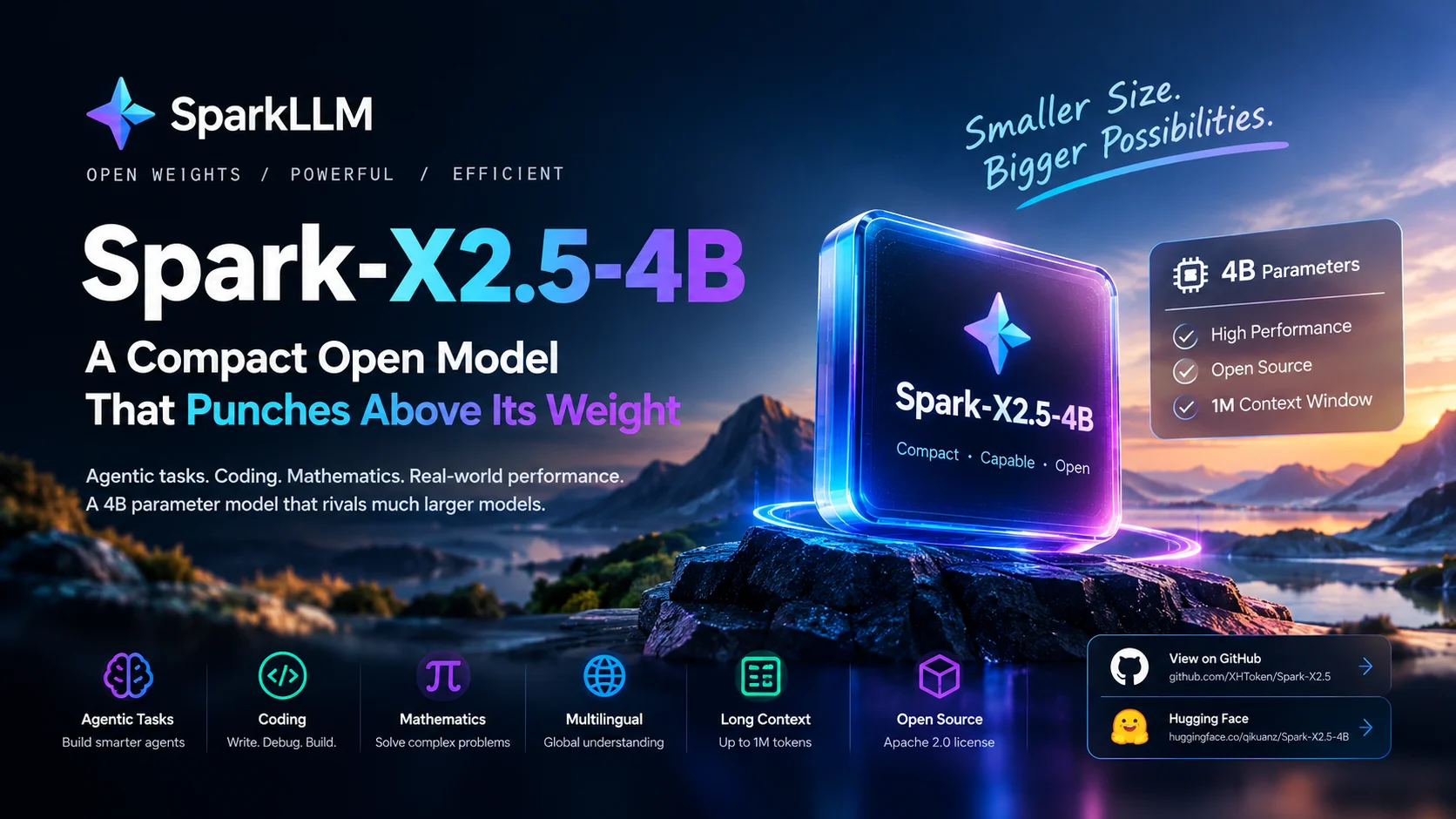
One model attracting attention is Spark-X2.5-4B, a compact, open-weight language model developed by the SparkLLM team. It is designed for reasoning, coding, tool use, multilingual tasks, and AI agent workflows. Despite belonging to the 4-billion-parameter class, it reports strong results on several benchmarks compared with substantially larger open models.
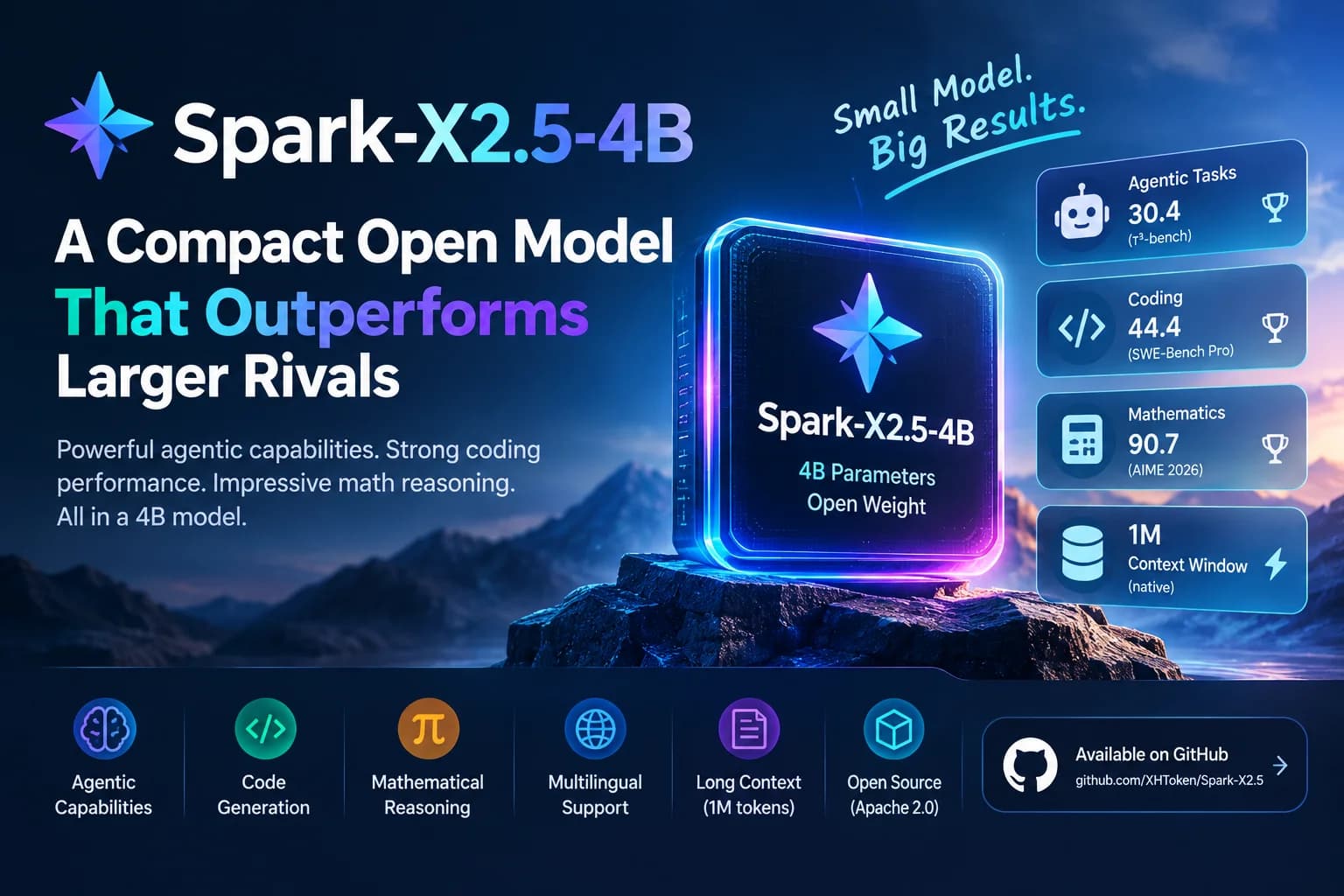
Its reported performance on agent-oriented evaluations is particularly interesting. Spark-X2.5-4B scores 30.4 on τ³-bench, 54.6 on MCP-Atlas, and 40.9 on BrowseComp. It also reports a score of 44.4 on SWE-Bench Pro, a benchmark used to evaluate software engineering capabilities.
But impressive benchmark numbers are only part of the story. How does Spark-X2.5-4B work, what makes it different, where can developers download it, and is it worth trying for local AI development?
Here is everything you need to know about Spark-X2.5-4B, its reported capabilities, technical design, availability, and potential use cases.
What Is Spark-X2.5-4B?
Spark-X2.5-4B is an open-weight large language model developed by the SparkLLM team associated with iFLYTEK's Spark AI model ecosystem.
Released in 2026, it belongs to the Spark-X2.5 model family, which also includes the smaller Spark-X2.5-1.7B variant.
Unlike AI models that depend entirely on a hosted service, Spark-X2.5-4B can be downloaded and deployed in supported environments. This gives developers more control over where inference happens and how the model fits into their applications.
The model is designed for a range of tasks, including:
AI agents and tool calling.
Code generation and software engineering.
Mathematical reasoning and problem-solving.
General question answering and writing.
Multilingual text processing.
Long-context document analysis.
Local and edge-oriented AI applications.
One of its most interesting features is its reported native context window of up to one million tokens. This is an unusually large context window for a model in the 4B parameter class, although practical performance depends on the inference runtime, memory availability, and deployment configuration.
Explore the model: Spark-X2.5 GitHub repository
Spark-X2.5-4B Benchmark Results: What Makes It Stand Out?
The Spark-X2.5 repository publishes comparisons against models including Qwen3.5 and Gemma4. The reported results suggest that Spark-X2.5-4B is especially competitive on selected agentic, browsing, and coding evaluations.
It is important to interpret these results carefully. Benchmark scores can depend on the evaluation harness, prompting strategy, tool configuration, model version, and scoring method. They should not be treated as a guarantee of real-world performance.
1. Strong Results on AI Agent Benchmarks
AI agents need to do more than generate convincing text. They may need to follow instructions, interact with tools, navigate environments, and complete multi-step tasks.
Spark-X2.5-4B reports the following scores on selected agent-related benchmarks:
τ³-bench: 30.4
MCP-Atlas: 54.6
BrowseComp: 40.9
VitaBench2.0: 25.2
In the published comparison, Spark-X2.5-4B outperforms the listed Qwen3.5-9B and Gemma4-12B entries on these particular benchmarks.
For example, on τ³-bench, Spark-X2.5-4B scores 30.4, compared with 9.3 for Qwen3.5-9B and 13.3 for Gemma4-12B.
The BrowseComp results show a similar pattern: Spark-X2.5-4B records 40.9, compared with 8.3 for Qwen3.5-9B and 10.0 for Gemma4-12B.
These results make the model worth evaluating for developers building tool-using agents, automated research systems, and applications that need to perform multi-step tasks.
However, the results are not universal. On τ²-bench, for instance, the listed Qwen3.5-9B score is higher than Spark-X2.5-4B's score. This is a useful reminder that model rankings can change significantly between benchmarks.
2. Competitive Coding and Software Engineering Performance
Coding is another area where Spark-X2.5-4B has attracted attention.
The published benchmark results include:
SWE-Bench Pro: 44.4
SWE-Bench Verified: 41.6
SWE-Bench Multilingual: 53.3
SWE-Bench evaluates models on software engineering tasks involving real codebases. Rather than simply asking a model to write a short function, these evaluations can involve understanding an existing project, identifying the source of a problem, and generating a patch that addresses it.
On SWE-Bench Pro, the published comparison lists Spark-X2.5-4B at 44.4, ahead of Qwen3.5-9B at 33.8 and Gemma4-12B at 21.9.
The multilingual SWE-Bench result of 53.3 is also notable, suggesting that the model may be worth testing in development workflows involving code and instructions across multiple languages.
There is an important qualification, though: Spark-X2.5-4B does not lead every coding evaluation. Its reported SWE-Bench Verified score of 41.6 is below the listed Qwen3.5-9B score of 53.1.
For developers, the practical takeaway is to evaluate the model on the programming languages, repositories, and tasks they actually use. A benchmark score alone cannot establish whether it will outperform another model in a specific coding assistant or autonomous software engineering workflow.
3. Mathematical Reasoning and Problem-Solving
Mathematical reasoning is another reported strength.
The published results include:
AIME 2026: 90.7
HMMT February 2026: 81.2
IMO-AnswerBench: 74.2
These evaluations examine different aspects of mathematical problem-solving, from competition-style questions to answer accuracy on more challenging mathematics tasks.
The AIME 2026 score is particularly interesting because it suggests that a compact model can perform strongly on a demanding mathematical evaluation.
Nevertheless, mathematical benchmarks should be interpreted according to their exact evaluation settings. Tool access, reasoning configurations, answer extraction, and test methodology can all affect results. These numbers should not be treated as proof that Spark-X2.5-4B is the best mathematics model in every scenario.
For developers, researchers, and students experimenting with local AI, the results provide a reason to include Spark-X2.5-4B in comparative testing.
How Can a 4B Model Compete With Larger AI Models?
A model's parameter count is an important specification, but it does not tell the whole story about capability.
Training methods, data quality, architecture, inference settings, and task-specific optimization can all influence the final results.
Spark-X2.5 uses a hybrid attention design that combines full attention with sliding-window attention. According to its model documentation, the architecture uses one full-attention layer followed by three sliding-window attention layers.
This arrangement is intended to reduce the computational overhead associated with processing long sequences while retaining the ability to incorporate broader context.
The model's development also emphasizes agentic capabilities, coding, reasoning, and tool use. These areas are important for applications where a model must do more than produce a plausible response.
The combination of an efficiency-oriented architecture and targeted training helps explain why Spark-X2.5-4B can be competitive on selected evaluations despite its relatively compact size.
It does not mean that parameter count has become irrelevant. Larger models may still perform better on particular tasks, and the overall quality of an application depends on more than the underlying model alone.
A One-Million-Token Context Window: Why It Matters
One of Spark-X2.5-4B's most notable advertised features is its native context window of up to one million tokens.
A context window determines how much input a model can consider during a single interaction or processing request, subject to the model's configuration and runtime support.
A very large context window can be useful for applications involving:
Large code repositories.
Long technical documents.
Extensive documentation collections.
Multi-document research workflows.
Long conversation histories.
Large amounts of structured text.
For example, a developer could investigate whether the model can analyze several files from a software project together rather than repeatedly supplying small fragments.
However, a one-million-token context window does not automatically mean every deployment can process that much text efficiently. Memory requirements, attention implementation, context configuration, and inference speed all matter.
Developers should also test how accurately the model retrieves information from different positions in a long input. The ability to accept a large context is not the same as consistently reasoning over every part of it.
For production use, begin with a realistic workload and measure latency, memory consumption, and answer quality before increasing the context length.
Spark-X2.5-4B vs. Spark-X2.5-1.7B
The Spark-X2.5 family also includes Spark-X2.5-1.7B, a smaller model designed for environments where memory and compute resources are more limited.
The two variants offer different trade-offs.
Spark-X2.5-4B is the more suitable starting point when reasoning quality, agentic tasks, and coding performance are priorities and the available hardware can support it.
Spark-X2.5-1.7B is worth testing when model size, deployment footprint, and resource constraints are more important.
The published comparison shows that the 1.7B version also performs competitively on selected benchmarks. For example, it records 20.1 on τ³-bench, 29.7 on BrowseComp, and 23.3 on SWE-Bench Multilingual.
Its performance is generally lower than the 4B version on these selected evaluations, but that does not automatically make it the worse choice for every application.
If you are building an application for resource-constrained devices, the smaller variant may be a better starting point. If you need stronger results on demanding agent or coding tasks, test the 4B model first.
Is Spark-X2.5-4B Open Source?
Spark-X2.5-4B is distributed as an open-weight model under the Apache License 2.0, according to its published repository.
This is important for developers who want to inspect the implementation, download model weights, experiment with deployment, and potentially use the model in commercial projects.
However, it is useful to distinguish between open weights and a completely reproducible open-source training process. Access to model weights and inference code does not necessarily mean that every training dataset, intermediate artifact, or detail of the original training process is available.
Before deploying the model commercially, review the license included with the specific repository or model distribution you intend to use, along with the terms of any runtime, hosted API, or third-party service.
Useful links:
These links provide starting points for examining the model, accessing weights, reviewing the benchmark claims, and exploring available deployment options.
How to Run Spark-X2.5-4B Locally
If you want to experiment with Spark-X2.5-4B, start by checking which inference tools currently support its architecture.
Model compatibility can change as frameworks add support for new architectures, so do not assume that every version of every popular local AI application will run it immediately.
The project's GitHub repository documents the following developments:
Native support in llama.cpp.
Integration with Ollama.
Support in LM Studio.
Deployment support for vLLM and SGLang in supported environments.
FP8 and INT8 quantized model variants.
You can begin with the project's official instructions here:
Open the Spark-X2.5 GitHub repository
Option 1: Use Ollama
Ollama is a popular way to run language models locally through a command-line interface and local API.
The Spark-X2.5 project documents Ollama support. However, the exact model tag and installation command can change, so check the repository or Ollama model library for the current instructions before running a command.
Start by installing Ollama from its official website:
Then search the model library or consult the project's documentation for the correct Spark-X2.5 model identifier.
Once the model is installed, you can test ordinary prompts, coding tasks, and tool-use scenarios. For a serious evaluation, record the model version, quantization, hardware, context settings, and generation parameters.
Option 2: Use llama.cpp
llama.cpp is a widely used inference engine for running supported language models across different hardware configurations.
The Spark-X2.5 project announced native architecture support in llama.cpp. Compatibility still depends on the version you install and the format of the model weights.
Consult the project's repository and the relevant llama.cpp documentation before downloading a model variant or following third-party installation instructions.
Official repository:
https://github.com/ggml-org/llama.cpp
Option 3: Deploy with vLLM or SGLang
For developers building an inference service, vLLM and SGLang may be relevant deployment options where the required model architecture and hardware are supported.
The Spark-X2.5 project documents deployment support for these frameworks in supported environments, including Ascend NPU deployments.
Before using either framework, verify the supported version, accelerator requirements, model format, and context configuration. A deployment recipe for one hardware platform may not work on another.
Official repositories:
What Hardware Do You Need?
Although Spark-X2.5-4B is compact compared with much larger language models, it still needs sufficient memory and a compatible inference runtime.
The exact requirements depend on the model format and quantization.
In general, consider the following factors:
Model weights: Lower-precision or quantized versions can reduce memory requirements.
Context length: Longer inputs can increase memory use substantially.
Inference engine: Different runtimes have different compatibility and memory characteristics.
CPU or GPU: Available compute resources influence generation speed.
Concurrent requests: Serving multiple users can require additional memory and processing capacity.
The model's repository documents FP8 and INT8 variants, which may offer a more manageable deployment footprint than higher-precision weights on compatible hardware.
Do not choose hardware based only on the model's parameter count. Test the exact model file and inference engine you intend to use, especially if you plan to run a large context window.
Best Use Cases for Spark-X2.5-4B
Spark-X2.5-4B is worth evaluating in several types of projects.
AI coding assistants
Developers can test it for code explanations, debugging suggestions, code generation, and repository-level tasks. Its SWE-Bench results make software engineering an especially relevant area to investigate.
Tool-using AI agents
The model's reported agent benchmark performance makes it a candidate for applications that combine language understanding with tool calls, external APIs, and multi-step workflows.
Real-world reliability will still depend on the agent framework, tool definitions, error handling, and permissions.
Local AI applications
Open weights and supported local inference options can give developers more control over where their workloads run. This may be useful when evaluating offline functionality, deployment costs, or data-handling requirements.
Local execution does not automatically guarantee privacy or security. Applications must still handle logs, files, network access, and user data appropriately.
Long-document analysis
The advertised long context may be useful for investigating large documents, source-code collections, or technical references. Test retrieval accuracy and reasoning quality on your own documents before relying on the model for important decisions.
Mathematical and reasoning tools
The published mathematics results suggest that Spark-X2.5-4B deserves consideration for structured reasoning tasks. Validate its accuracy against a representative set of problems before integrating it into an educational or analytical product.
Limitations to Consider Before Using Spark-X2.5-4B
Despite its promising results, Spark-X2.5-4B is not a universal replacement for larger language models.
First, benchmark performance varies by task. The model leads some entries in the published comparison but falls behind on others, including τ²-bench and SWE-Bench Verified.
Second, model size alone does not establish speed. Actual performance depends on hardware, quantization, context length, and inference implementation.
Third, a very large context window is not a guarantee of perfect recall or reliable reasoning over long documents.
Fourth, agentic applications require more than a capable model. They need reliable tool execution, permission controls, validation, and safeguards against unintended actions.
Finally, open weights do not eliminate the need to review licensing, security, and deployment requirements.
The best approach is to treat Spark-X2.5-4B as a promising candidate and evaluate it against alternatives using the tasks your application actually needs to complete.
Final Verdict: Is Spark-X2.5-4B Worth Trying?
Spark-X2.5-4B is an interesting development in compact language models. Its reported results on agentic benchmarks, BrowseComp, and SWE-Bench Pro suggest that a relatively small model can be competitive with larger alternatives in selected workloads.
Its open-weight availability, documented inference integrations, and advertised one-million-token context window make it particularly relevant to developers experimenting with local AI, software engineering agents, and long-context applications.
Still, the benchmark picture is mixed rather than universally dominant. The model performs strongly in some evaluations but does not lead every category. That is why hands-on testing matters more than a headline ranking.
If you are a developer looking for a compact model to experiment with, Spark-X2.5-4B is worth adding to your evaluation list.
Start with the official GitHub repository, review the published benchmarks, select a supported inference runtime, and test it on your own workload.
Get started: Spark-X2.5 on GitHub
Frequently Asked Questions
What is Spark-X2.5-4B?
Spark-X2.5-4B is an open-weight language model from the SparkLLM team. It is designed for general language tasks, reasoning, coding, tool use, and agentic workflows.
Is Spark-X2.5-4B better than Qwen3.5-9B?
It outperforms the listed Qwen3.5-9B result on several published benchmarks, including τ³-bench, BrowseComp, and SWE-Bench Pro. However, Qwen3.5-9B scores higher on other evaluations, so neither model is universally better across all tasks.
Is Spark-X2.5-4B free to download?
Its weights and code are publicly available through the project's distribution channels under the published Apache 2.0 license. Hosted services, hardware, and infrastructure may still incur costs.
Can Spark-X2.5-4B run locally?
Yes, in compatible inference environments. The project documents support for tools such as Ollama, llama.cpp, and other inference frameworks. Check the latest compatibility instructions before installation.
Does Spark-X2.5-4B support a one-million-token context window?
The model documentation advertises a native context window of up to one million tokens. Actual usable context depends on the inference engine, configuration, memory, and deployment environment.
Can Spark-X2.5-4B be used commercially?
The published model repository lists the Apache 2.0 license, which generally permits commercial use subject to its terms. Review the license and the conditions associated with the exact model distribution and deployment tools you use.