How to Get $4,000 in Free Startup Credits in 2026: Google Cloud, AWS and Deepgram
Learn how to apply for $4,000 in potential startup credits from Google Cloud, AWS Activate and Deepgram, plus extra Azure and Cloudflare offers.
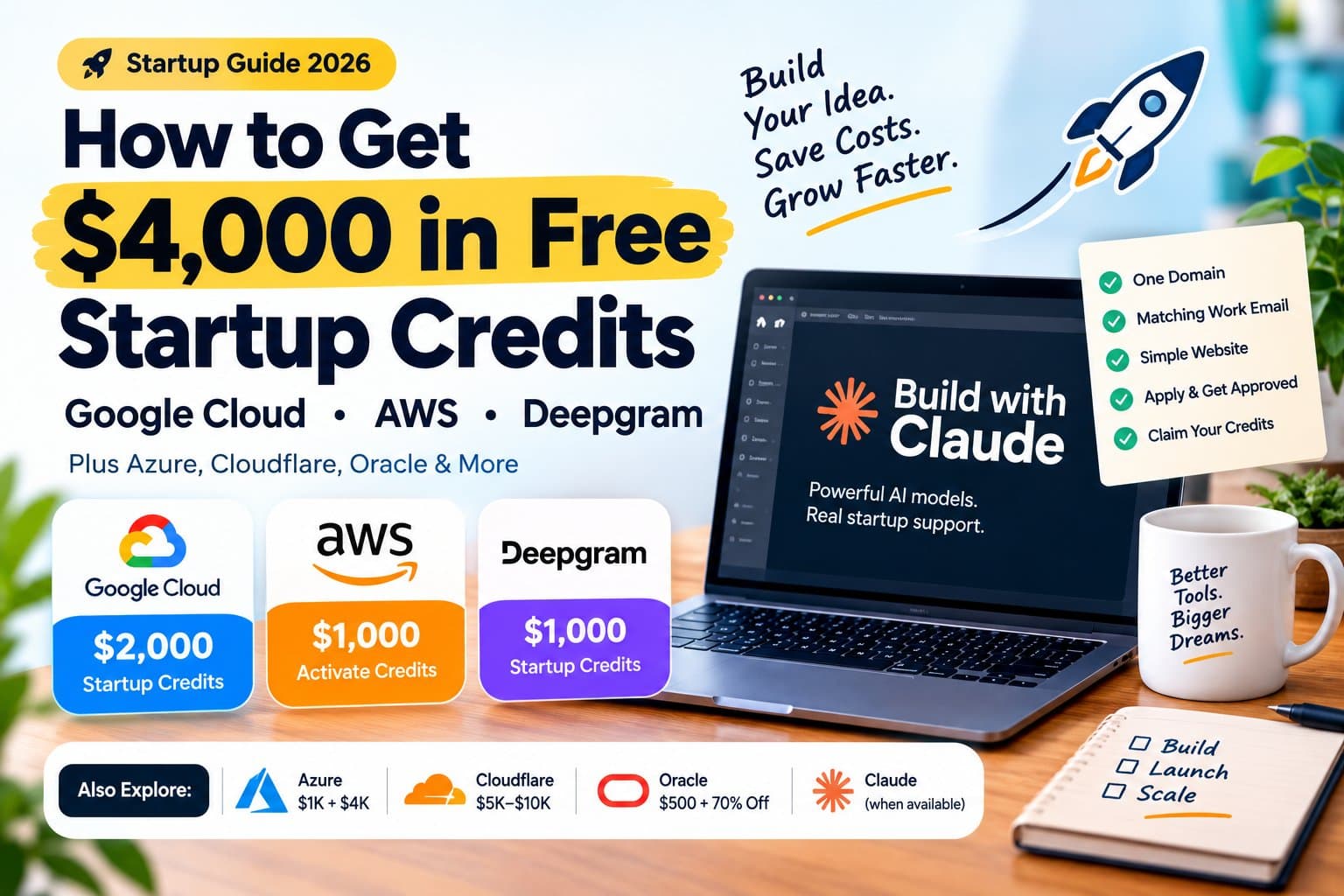
Want to get $4,000 in free startup credits without spending thousands on cloud infrastructure and AI APIs? If you're building a real software product, AI application, SaaS platform, or technology startup, several companies offer startup credit programs that can help you reduce your initial development costs.
You may be eligible for $2,000 in Google Cloud credits, $1,000 in AWS Activate credits, and $1,000 in Deepgram startup credits. Together, these offers can provide a potential starting package worth $4,000 in service credits, subject to each provider's eligibility requirements and approval.
The process isn't simply about creating accounts and collecting free credits. You need a credible product, a clear business model, a working website, and accurate company information. A professional email address using your own domain can also help establish your company's identity when applying.
In this guide, you'll learn how to prepare your startup, apply for each program, avoid common rejection reasons, and explore additional startup credits from Microsoft Azure, Cloudflare, Oracle, and Anthropic.
What Are Startup Credits?
Startup credits are promotional balances offered by cloud providers and technology companies to help eligible early-stage businesses build, test, and launch products.
Instead of paying the full price for eligible services immediately, approved startups can use their credits to cover qualifying expenses. Depending on the provider, these services may include:
Cloud hosting and computing.
Databases and storage.
Artificial intelligence and machine learning.
Speech recognition and text-to-speech APIs.
Application testing and deployment.
Developer infrastructure and other eligible services.
Important: Startup credits are not cash. They generally cannot be withdrawn, transferred freely, or used for every service. Each provider sets its own eligibility rules, usage restrictions, and expiration dates.
1. Get $2,000 in Google Cloud Startup Credits
Official application: https://cloud.google.com/startup/pre-funded
Google Cloud's Start tier is designed for eligible early-stage technology startups that are building a product and preparing to grow.
The program advertises up to $2,000 in Google Cloud credits, valid for 12 months, for eligible pre-funded startups. Other benefits may also be available.
Who can apply for Google Cloud startup credits?
According to Google's published eligibility criteria, applicants for the Start tier generally need to:
Be a digital-native technology startup.
Have a working minimum viable product (MVP).
Have a clear business model and product roadmap.
Have been founded within the previous 24 months.
Plan to seek venture funding soon.
Not have received Google Cloud credits beyond the free-trial allowance.
Google evaluates applications against its program criteria, so meeting the basic requirements does not guarantee acceptance.
How to apply
Build a functioning website that explains your actual product.
Make sure your product description, company name, and contact information are consistent.
Prepare a clear explanation of your MVP, target customers, business model, and development plans.
Visit the official Google Cloud startup application page.
Select the appropriate startup program and submit your application.
Monitor your email for a decision or requests for additional information.
Google may request company and billing details during the application process. Keep your information accurate and have your Google Cloud billing account details available if requested.
How long does approval take?
Application processing times vary. Some applications may be processed quickly, while others require additional review.
Credit duration: 12 months for the advertised Start-tier credits.
Best for: Early-stage technology startups with a working MVP and a credible growth plan.
2. Get $1,000 in AWS Activate Credits
Official application: https://aws.amazon.com/startups/credits
Amazon Web Services offers AWS Activate, a startup program that helps founders access cloud infrastructure without paying all eligible service costs upfront.
The Activate Founders tier starts with $1,000 in AWS Activate credits. Select startups may qualify for additional credits, potentially reaching $5,000 under the program's terms.
AWS Activate Founders eligibility
The published Founders-tier requirements include:
Being self-funded or bootstrapped.
Having a functioning company website.
Having been founded within the last 10 years.
Being new to AWS Activate credits.
Meeting the program's other account and application requirements.
AWS also offers a separate Portfolio tier for eligible startups connected to approved accelerators, investors, and other Activate Providers.
How to apply for AWS Activate
Create or prepare your AWS account.
Set up your AWS Builder ID using an email address you can access.
Build a professional website that clearly explains your product.
Gather your company profile, funding stage, and product information.
Visit the official AWS Activate page.
Choose the tier that matches your situation and submit the application.
Follow the instructions provided by AWS and check your application status.
AWS account and billing requirements can vary by program and account status. Read the current eligibility conditions carefully before applying rather than assuming that every free-tier account qualifies.
Can you get more than $1,000?
Potentially. AWS states that selected startups may qualify for additional credits up to $5,000 through the Founders tier. The higher amount is not guaranteed for every applicant.
Best for: Bootstrapped founders who need cloud hosting, computing, storage, databases, or other eligible AWS services.
3. Get $1,000 in Deepgram Startup Credits
Official application: https://deepgram.com/startup-program
Deepgram provides speech AI technology for applications that need speech-to-text, text-to-speech, and voice-agent capabilities.
Its Startup Program advertises a $1,000 starting credit offer for eligible direct applicants, with opportunities for selected startups to qualify for larger packages worth up to $100,000, depending on eligibility and applicable partner arrangements.
Who should apply?
Deepgram's published criteria focus on builders and early-stage startups that:
Are developing an AI product or voice-enabled application.
Are already in production or expect to launch within the next six months.
Have a genuine use case for Deepgram's technology.
Are committed to actively building their product.
The program is designed for startups developing their own products, not agencies or consultants building products on behalf of clients.
How to apply
Create a Deepgram account.
Open your console and locate your Project ID.
Prepare a concise explanation of your startup and how you intend to use speech AI.
Visit the official Deepgram Startup Program page.
Complete the application with accurate company and product details.
Wait for the review decision.
Deepgram says it typically responds within about one week. After acceptance, credits are generally deposited within 24–48 hours.
Credit duration: 12 months from the date the credits are issued.
Best for: AI developers building transcription tools, voice assistants, meeting applications, customer-support agents, and other speech-powered products.
How the $4,000 Startup Credit Package Adds Up
The potential base package combines three separate programs.
Google Cloud Start tier: up to $2,000.
AWS Activate Founders: starting at $1,000.
Deepgram Startup Program: starting at $1,000 for eligible direct applicants.
Potential total: $4,000 in service credits.
These are separate applications with separate approval processes. One company may qualify for all three, but approval from one provider does not guarantee approval from another.
The credits also cover different services, so you should choose the programs that match your actual technology stack. Google Cloud and AWS can support general cloud infrastructure, while Deepgram is particularly relevant to speech AI applications.
Before You Apply: Set Up Your Startup Properly
A common mistake is applying with incomplete company information, a generic email address, or a website that does not explain what the business does.
A professional online presence can make your application easier to verify. However, buying a domain or creating a work email does not automatically make a business eligible.
Step 1: Buy a domain for your business
Choose a domain that reflects your actual product or company.
A .com domain is a familiar option, but it isn't the only legitimate choice. Compare registration and renewal prices before purchasing. The cost may be around $10 per year for some domains, but the actual price depends on the registrar, extension, and any promotions.
For example, you might use:
yourstartup.comyourproduct.aiyourcompany.dev
Use a domain you intend to maintain, and enable domain privacy where available and appropriate.
Step 2: Create a professional email address
An address such as founder@yourstartup.com looks more consistent with a company website than a generic personal address.
You can investigate email hosting options that fit your budget, including free plans where available. Zoho Mail and other providers may offer different plans depending on region, eligibility, and current terms.
To connect your domain, follow your email provider's setup instructions. These commonly involve configuring:
MX records for receiving email.
SPF to help authorize legitimate outgoing mail.
DKIM to authenticate outgoing messages.
DMARC to define how receiving systems should handle authentication failures.
DNS changes may take time to propagate, so test your email before using it for applications.
Important: Some startup programs require a company email, while others accept different contact addresses. A Gmail address does not automatically disqualify every applicant. Follow each program's published requirements and use truthful, consistent information.
Step 3: Build a simple but credible website
You don't necessarily need a large website to explain an early-stage product. A clear, functional landing page can be a good starting point.
Include the following:
Product name: Use the name customers will recognize.
Product description: Explain what you're building.
Problem and solution: Describe the problem your product addresses.
Features: Highlight the main functionality.
Target audience: Identify who the product is for.
Contact information: Provide a working company email.
Privacy policy and terms: Add these where appropriate for your product and data practices.
If you have a working MVP, include a demo, screenshots, documentation, or a product link where appropriate.
Do not create a fake business, misrepresent your product's progress, or publish placeholder claims simply to qualify for credits. Startup programs are intended to support genuine businesses and builders.
Step 4: Keep company information consistent
Before applying, check that your company name, website, work email, product description, and billing information are accurate.
Some programs verify domain ownership or compare company details across their application and billing systems. Others have different requirements.
Where a program requires matching information, make sure it genuinely matches. Do not change billing or identity details just to make an application appear eligible.
Additional Startup Credit Programs Worth Exploring
After applying for Google Cloud, AWS, and Deepgram, investigate these additional options. They may provide further savings, but their offers and requirements are different.
Microsoft Azure for Startups
Official information: https://learn.microsoft.com/en-us/startups/microsoft-for-startups/mfs-faqs
Microsoft offers Azure startup credits through its startup programs. For eligible new Azure customers, Microsoft's published self-serve offer provides $1,000 in credits for 90 days, with an additional $4,000 available for 180 days after business verification, subject to the current offer's requirements.
That can provide up to $5,000 in Azure credits through the relevant offer. Verify your eligibility and the current terms before relying on that amount.
Cloudflare for Startups
Official application: https://www.cloudflare.com/startups/
Cloudflare's startup program offers credits for eligible companies at different stages. Its published program includes a bootstrapped or self-funded tier advertising $10,000 in credits for startups that meet its criteria.
Other tiers may offer larger packages to eligible funded startups. Check the current requirements and service restrictions before applying.
Oracle for Startups
Official information: https://www.oracle.com/startup/
Oracle has offered startup benefits involving cloud credits, discounts, and technical resources. The exact package available to a particular company can depend on the program and its current terms.
Check the official startup page for the latest offer rather than assuming a particular credit amount or discount will be available to every applicant.
Claude for Startups
Official program: https://claude.com/programs/startups
Anthropic's Claude for Startups program has advertised a free year of Claude Team for eligible startups, subject to seat and account conditions, plus a one-time $1,000 Claude API credit.
Program capacity and eligibility can change. Check the official page to confirm whether applications are currently being accepted and whether the benefits are available to your company.
Common Reasons Startup Credit Applications May Be Rejected
A professional email and website can help establish credibility, but they are not substitutes for eligibility.
Here are mistakes worth avoiding.
1. Using an email that doesn't meet the program's requirements
Some programs request a company-domain email or verify that your email domain matches your website. If that is a stated requirement, follow it.
Do not assume every provider rejects Gmail addresses. Read the specific rules before applying.
2. Having no real product or clear business model
If your website does not explain what you build, who it serves, or how you intend to use the provider's services, reviewers may struggle to assess your application.
Describe the product honestly, even if it is still at the MVP stage.
3. Applying to a program your company doesn't qualify for
Google's Start tier, AWS Activate Founders, and Deepgram's program have different eligibility criteria. Funding stage, company age, product maturity, previous credits, and intended use can all matter.
Check the official requirements before spending time on an application.
4. Misrepresenting your business
Do not invent a company, fabricate customers, claim a nonexistent product, or use inaccurate funding information.
A domain and landing page should represent a genuine project, not a way to disguise an ineligible application.
5. Assuming application means approval
Submitting a form does not guarantee credits. Each provider can approve, decline, or request more information. Wait for confirmation before planning your infrastructure budget around a credit grant.
6. Forgetting expiration dates and usage limits
Credits can expire or apply only to selected services. Check your billing console regularly, understand which services qualify, and set spending alerts where available.
How to Make the Most of Your Startup Credits
Getting approved is only the first step. The real value comes from using the credits to develop and validate your product.
A practical approach is to:
Prioritize your MVP. Spend credits on the infrastructure required to build and test the core product.
Choose providers based on your needs. Avoid deploying services across multiple platforms unless doing so provides a real technical or financial benefit.
Monitor usage. Configure budgets, alerts, and cost reports wherever available.
Track expiration dates. Use credits within their validity periods rather than leaving them unused.
Test before scaling. Measure performance and costs before moving to larger workloads.
Prepare for paid usage. Know what your monthly bill could look like once credits run out.
Remember that a credit balance does not necessarily cover every cost associated with a service. Some products, features, regions, or third-party integrations may be excluded.
Frequently Asked Questions
Can I really get $4,000 in free startup credits?
Potentially. The combined package consists of up to $2,000 from Google Cloud, $1,000 from AWS Activate Founders, and a $1,000 starting offer from Deepgram for eligible direct applicants. Each provider has its own approval process and conditions.
Do I need a registered company?
Requirements vary by program and country. Some programs focus on startup age, product maturity, funding stage, or business verification. Review the official eligibility rules and provide accurate information about your business.
Do I need a custom-domain email?
Not for every program, but a company-domain email may be required or useful when a provider verifies your website and company details. Check each application's current requirements.
Can I apply if my startup is bootstrapped?
Yes, some programs explicitly support self-funded or bootstrapped startups. AWS Activate Founders and Cloudflare's bootstrapped tier are examples, subject to their respective eligibility criteria.
Google Cloud's Start tier has specific requirements, including a working MVP and plans to seek venture funding soon, so it may not suit every bootstrapped business.
Can I apply to all these programs?
You can investigate each program independently, but eligibility, prior-credit restrictions, and terms may affect whether you qualify. Read each provider's rules and answer all questions honestly.
Are startup credits the same as cash?
No. Startup credits are promotional balances for eligible services. They generally cannot be withdrawn as money or used without restriction.
What happens when my credits expire?
Depending on your account and services, you may need to pay for continued usage or stop the services. Review billing settings, configure alerts, and understand your provider's post-credit pricing before the expiration date.
Final Thoughts
Startup credits can help founders reduce infrastructure costs while building a real product. A potential $4,000 starting package from Google Cloud, AWS, and Deepgram can be a useful first step, and additional programs from Microsoft Azure, Cloudflare, Oracle, and Anthropic may offer further opportunities.
Start by preparing a credible website, using consistent company information, and documenting your product and business model. Then apply to the programs that genuinely fit your startup.
The practical strategy is simple: build something real, present it professionally, apply honestly, and track every credit you receive. A custom domain and work email can help establish your business identity, but the strongest application is one that clearly demonstrates what you're building and why you need the technology.
Program terms, credit amounts, eligibility, and availability can change. Always confirm the latest details on the provider's official website before applying.