Spark-X2.5-4B: The Tiny AI Model With a 1M-Token Context Window
Discover Spark-X2.5-4B, the small 4B AI model with a huge 1M token context window. Experience powerful local reasoning, coding, and agent workflows.
Small AI models are getting surprisingly capable.
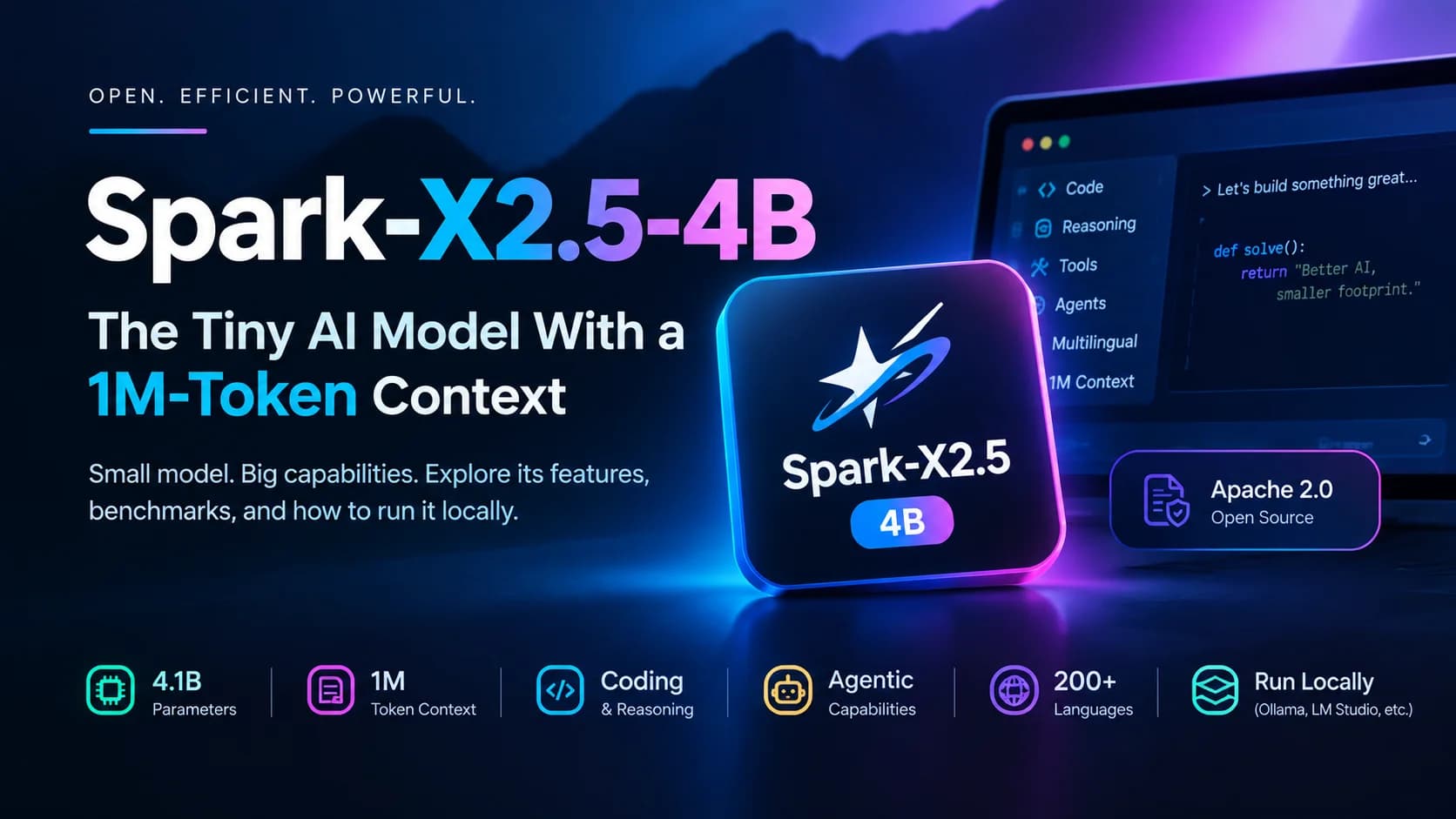
The latest example is Spark-X2.5-4B, an open-weight language model from the SparkLLM team that is designed to bring reasoning, coding, tool use, and agentic workflows to relatively small hardware.
At around 4.1 billion parameters, Spark-X2.5-4B is tiny compared with many of today's frontier AI models. Yet it supports a native context window of up to 1 million tokens, supports more than 200 languages, and reports surprisingly strong results on coding, mathematics, tool use, and agent benchmarks.
That combination makes Spark-X2.5-4B particularly interesting for developers who want to run AI locally rather than sending every prompt to a cloud API.
So what exactly is Spark-X2.5-4B, how does it work, and is a 4B model really powerful enough for serious AI workloads?
Let's take a closer look.
What Is Spark-X2.5-4B?
Spark-X2.5-4B is a compact, general-purpose reasoning model developed by the SparkLLM team.
The Spark-X2.5 family launched globally in September 2026 with two main models:
Spark-X2.5-4B
Spark-X2.5-1.7B
The 4B model is the larger and more capable version, while the 1.7B model targets even lighter local deployment.
The models are designed for everyday conversation, writing, translation, reasoning, coding, tool use, and agentic workflows. The project is released under the Apache 2.0 license, making the model particularly attractive for developers who want open weights and flexibility in how they deploy it.
Unlike many small models that simply trade capability for a smaller parameter count, Spark-X2.5 focuses heavily on architectural efficiency.
Its most interesting feature may be the way it handles long context.
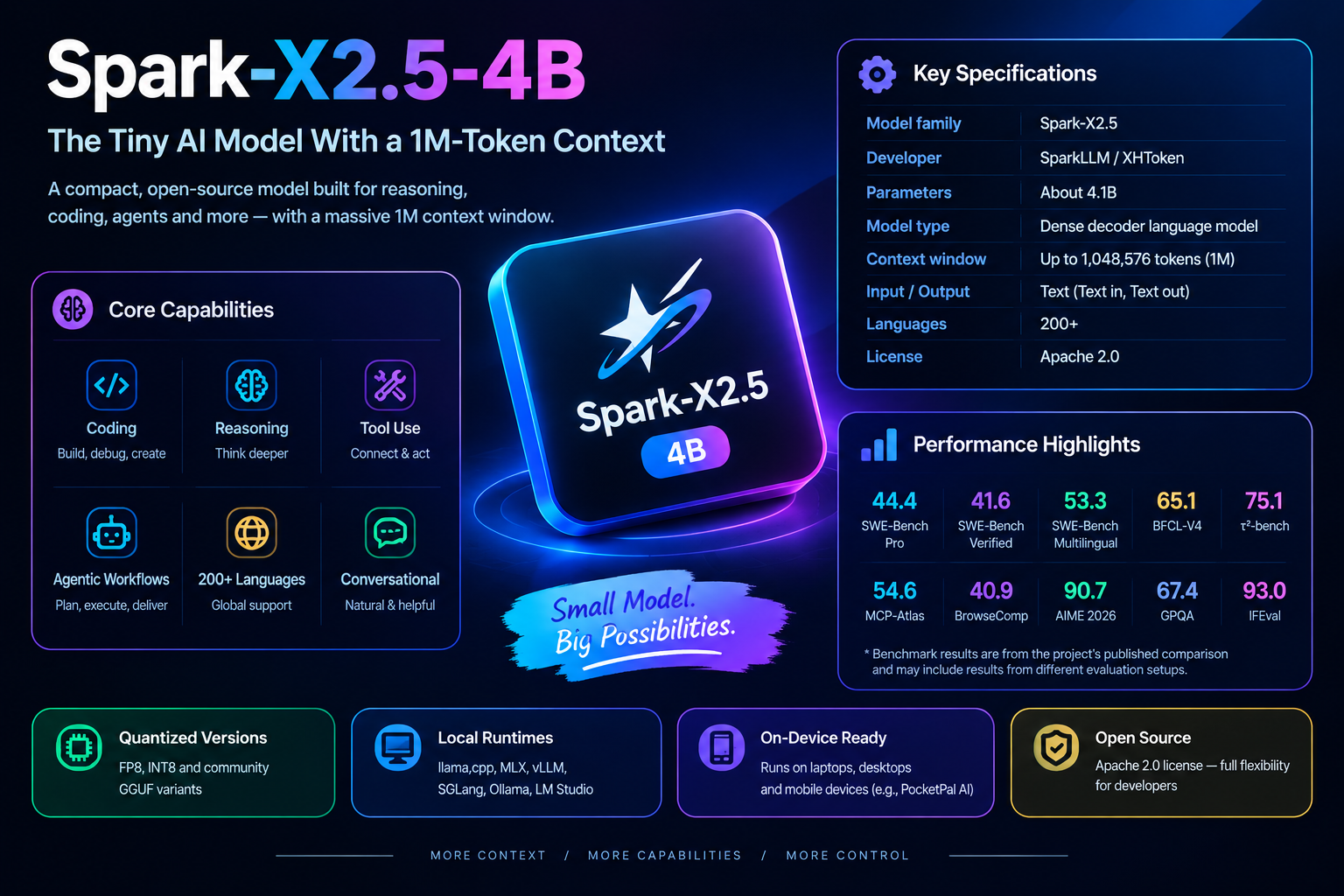
Spark-X2.5-4B Specifications
The Most Interesting Part: A 1 Million Token Context
The headline feature of Spark-X2.5-4B is its 1M-token context window.
That is unusually large for a model of this size.
Instead of applying full attention to every token throughout the entire context, Spark-X2.5 uses a hybrid architecture containing one full-attention layer followed by three sliding-window attention layers.
The idea is straightforward: preserve full attention periodically while reducing the computational cost of processing extremely long sequences.
This matters for workloads such as:
Large code repositories
Long documents
Research material
Large conversation histories
Agent memory
Multi-file software projects
Long-running tool workflows
However, there is an important distinction between supporting a 1M-token context and running a 1M-token context efficiently on a phone or laptop.
The model's native architecture supports up to 1,048,576 tokens, but actual usable context depends on the runtime, hardware, memory, and configuration.
So you shouldn't assume that a 4GB quantized model suddenly makes million-token inference cheap.
Why Hybrid Attention Matters
Traditional full attention becomes increasingly expensive as context grows.
Spark-X2.5 approaches the problem differently.
Its architecture alternates:
Full attention → sliding-window attention → sliding-window attention → sliding-window attention
and repeats the pattern.
The sliding-window layers restrict attention to a smaller local region, while the full-attention layer provides opportunities for information to connect across the broader sequence.
This architecture is one reason Spark-X2.5 can advertise a million-token context without simply scaling the computational requirements of every layer in the same way.
For local AI, that efficiency is potentially more important than having a huge parameter count.
Spark-X2.5-4B Benchmark Results
The benchmark numbers are what initially make Spark-X2.5-4B interesting.
According to the model's published comparison, the 4B model reports:
44.4 on SWE-Bench Pro
41.6 on SWE-Bench Verified
53.3 on SWE-Bench Multilingual
65.1 on BFCL-V4
75.1 on τ²-bench
54.6 on MCP-Atlas
40.9 on BrowseComp
90.7 on AIME 2026
67.4 on GPQA
93.0 on IFEval
These results are reported in the project's model comparison, which also includes larger models such as Qwen3.5-9B and Gemma4-12B. The model card notes that some comparison figures marked with an asterisk come from publicly released model cards or papers rather than being produced under exactly the same evaluation setup.
That caveat is important.
Benchmark scores should not be interpreted as proof that a 4B model universally beats larger models. Different models can have different prompting, tool access, sampling, and evaluation conditions.
But the results do demonstrate something useful:
Spark-X2.5-4B is punching above what its parameter count would normally suggest.
How Good Is Spark-X2.5-4B at Coding?
Coding is one of Spark-X2.5-4B's strongest areas.
The model reports a 44.4 score on SWE-Bench Pro, compared with 33.8 for the Qwen3.5-9B result included in its comparison table.
It also reports:
41.6 on SWE-Bench Verified
53.3 on SWE-Bench Multilingual
34.7 on SciCode
The model is also designed to work with agentic coding environments, with the project documentation listing integrations involving tools and agent harnesses such as Codex, Claude Code, OpenClaw, and Hermes.
That makes Spark-X2.5-4B more interesting than a small chatbot.
A model that can reason through a coding task, call tools, inspect results, and continue working can potentially be useful as a local development assistant.
Of course, benchmark performance doesn't guarantee that it will perform equally well on your particular codebase.
Spark-X2.5-4B for AI Agents
Agentic AI is another area where Spark-X2.5-4B is trying to differentiate itself.
The model reports strong results on several tool and agent benchmarks:
BFCL-V4: 65.1
τ²-bench: 75.1
τ³-bench: 30.4
MCP-Atlas: 54.6
MCP-Mark: 14.2
Workspace Bench: 31.2
VitaBench2.0: 25.2
BrowseComp: 40.9
The MCP and browsing results are particularly interesting because they test capabilities beyond ordinary question answering.
This reflects a broader trend in AI development.
The goal for small models isn't necessarily to create a miniature chatbot that answers trivia.
Instead, developers increasingly want small models that can act as components inside larger systems.
A 4B model running locally can potentially handle tool selection, structured tasks, coding assistance, document processing, or other repetitive agent operations without sending every request to an expensive frontier model.
How Good Is Spark-X2.5-4B at Mathematics?
The model also performs surprisingly well on several mathematical evaluations.
Its published results include:
AIME 2026: 90.7
HMMT February 2026: 81.2
IMO-AnswerBench: 74.2
Gaokao 2026: 133.4
These evaluations were conducted with the model's thinking mode enabled.
This is important because Spark-X2.5-4B isn't simply a small instruction-following model.
It is explicitly designed as a reasoning model.
When reasoning is enabled, the model works through a problem before producing its final response.
That can improve performance on mathematics, coding, and multi-step reasoning tasks, although it can also increase latency and token usage.
Spark-X2.5-4B Is a Reasoning Model
One of the easiest ways to misunderstand Spark-X2.5-4B is to look only at its parameter count.
The model has an explicit thinking/reasoning mechanism.
Its model configuration and compatible runtimes support a <think> channel, allowing the model to reason before producing its final answer.
This means the model can behave differently depending on whether thinking is enabled.
For simple tasks, you may not need extensive reasoning.
For mathematics, programming, or complex instructions, giving the model a larger thinking budget can be important.
The model documentation recommends allowing a sufficiently large output budget for reasoning tasks, with at least 2,048 tokens suggested and larger budgets for some mathematical problems.
Can You Run Spark-X2.5-4B Locally?
Yes.
This is one of the main reasons Spark-X2.5-4B is attracting attention.
The model is available through several local inference ecosystems, including:
llama.cpp
Ollama
LM Studio
MLX
vLLM
SGLang
The official project also provides quantized versions and deployment instructions for different hardware platforms.
Ollama
Ollama support was added to the Spark-X2.5 ecosystem in September 2026, making local experimentation considerably easier.
The official model listing identifies Spark-X2.5-4B as having a 1M-token context window.
If your Ollama installation supports the spark2_5 architecture, the model can be run through the normal Ollama workflow.
The ecosystem initially had a compatibility gap because older Ollama builds did not recognize the new architecture. Support was subsequently added as the relevant llama.cpp changes were incorporated.
LM Studio
Spark-X2.5 also gained LM Studio ecosystem support.
Because the model uses a relatively new spark2_5 architecture, users should make sure their LM Studio version includes a compatible llama.cpp engine rather than assuming every older installation will load it.
Apple Silicon
Spark-X2.5 can also be run through MLX-based tooling.
The project documentation provides MLX support for Apple silicon, Linux CPU, and NVIDIA CUDA environments.
This makes the model particularly interesting for developers who want to experiment with local AI on Apple Silicon hardware.
How Much RAM Does Spark-X2.5-4B Need?
This depends heavily on the precision and runtime you use.
The original model is around 4B parameters, but the actual memory requirement is affected by:
Model precision
Quantization
Context length
KV cache
Runtime overhead
GPU/CPU configuration
For example, a community LiteRT conversion lists an INT8 file around 4.24 GB and an INT4 file around 2.48 GB.
That doesn't mean you need only 2.5GB of total system memory.
The runtime, context cache, operating system, and other processes also require memory.
And the 1M-token context is a completely different workload from a normal 8K, 16K, or 32K context.
For practical local use, it makes more sense to start with a moderate context size and increase it only when your hardware can handle it.
Spark-X2.5-4B on Phones
The model's small size also makes on-device AI an interesting possibility.
The Spark-X2.5 project added native support to PocketPal AI in September 2026, bringing the model to mobile devices through an on-device AI application.
However, don't confuse being able to run a model on a phone with getting desktop-class performance.
A community test of an INT4 Spark-X2.5-4B build on a Galaxy S26 reported around 5 tokens per second in the measured configurations, while also showing that quantization could substantially reduce memory use.
So the model is genuinely interesting for mobile AI, but expectations should remain realistic.
The 1.7B version may be a better fit when extremely low memory usage and responsiveness matter more than maximum capability.
Spark-X2.5-4B vs Larger Models
One of the biggest questions is obvious:
How can a 4B model compete with models that have significantly more parameters?
The answer is that parameter count isn't the only thing that determines model performance.
Training quality, data, reinforcement learning, architecture, inference strategy, reasoning, and tool use all matter.
Spark-X2.5 combines several of these ideas:
Hybrid attention
Long-context training
Reasoning
Reinforcement learning
Tool-use training
Agent-oriented post-training
Efficient inference
The result is a model that attempts to maximize capability per parameter.
That doesn't make 4B parameters equivalent to a frontier-scale model.
A larger model can still provide advantages in complex reasoning, difficult coding, nuanced knowledge work, and other tasks.
But for many local workloads, a small model that is good enough, cheap enough, and fast enough can be more useful than a much larger model that requires a cloud API.
Why Spark-X2.5-4B Matters for Local AI
The most interesting thing about Spark-X2.5-4B isn't necessarily any individual benchmark.
It's the direction it represents.
AI is moving toward a world where users don't have to send every request to a giant cloud model.
Instead, different workloads can be distributed across different models.
A phone might use a 1.7B model for simple tasks.
A laptop could run the 4B model for coding, writing, and local reasoning.
A cloud-based frontier model could handle the hardest tasks.
That creates a hybrid AI stack where small local models and large cloud models work together.
Spark-X2.5-4B fits neatly into that future.
Spark-X2.5-4B Pros and Cons
Pros
Very small parameter count
Native 1M-token context
Strong reported coding performance for its size
Reasoning capabilities
Tool and agent support
200+ language support
Open Apache 2.0 license
Multiple local inference options
Quantized versions available
Works across different hardware ecosystems
Cons
A 1M context window does not mean 1M tokens are practical on every device
Performance varies significantly with hardware and quantization
Some ecosystem support initially required updated runtimes
Benchmark results are not directly comparable across every model
Larger frontier models can still have advantages on difficult tasks
Long reasoning can increase latency and memory requirements
Is Spark-X2.5-4B Worth Trying?
If you're interested in local AI, small language models, coding agents, or on-device inference, Spark-X2.5-4B is absolutely worth experimenting with.
Its combination of roughly 4B parameters, reasoning, coding capabilities, agentic workflows, and a native 1M-token context makes it unusual for its size.
The most important point, however, is not that Spark-X2.5-4B replaces every larger model.
It doesn't.
Instead, it demonstrates how much capability can now be packed into a relatively small open model.
For developers, that opens up interesting possibilities: private local coding assistants, offline AI applications, mobile assistants, lightweight agents, document processing, and hybrid local/cloud systems.
And with the model available under Apache 2.0, developers have considerably more freedom to experiment with deployment than they would with a closed API-only model.
Final Thoughts
Spark-X2.5-4B is a good example of where the small-model market is heading in 2026.
Instead of competing purely on parameter count, the model focuses on efficiency, reasoning, long context, coding, and agentic capabilities.
A 4B model with a native million-token context would have sounded unusual only a short time ago. Now, it is becoming a practical direction for local AI development.
The bigger question is no longer simply:
“How large is the AI model?”
It is:
“How much useful intelligence can we get from the hardware we already have?”
Spark-X2.5-4B is one of the more interesting attempts to answer that question.