Grok 4.7 vs GPT-6: Which AI Model Wins in Late 2026?
Grok 4.7 vs. GPT-6: Unsure which AI model suits your needs? Dive deep into pricing, coding, reasoning & agentic tasks to find your perfect fit!
The AI model race has accelerated again.
On September 3, 2026, OpenAI released GPT-6 Astra, its flagship model for advanced reasoning, coding, computer use, science, and professional work. Less than three weeks later, SpaceXAI launched Grok 4.7, targeting long-running coding and knowledge-work tasks. OpenAI then expanded its GPT-6 lineup with GPT-6 Sol and GPT-6 Luna on September 22.
That leaves many developers, businesses, and everyday AI users asking the same question:
Grok 4.7 vs GPT-6 — which AI model should you actually use?
The answer depends heavily on what you are doing.
Grok 4.7 is particularly interesting if you care about API cost, coding, long-running tasks, and professional knowledge work. GPT-6 Astra is positioned at the top end of OpenAI's lineup for demanding reasoning and agentic workflows, while GPT-6 Sol and Luna bring much of the GPT-6 technology to lower-cost use cases.
Rather than declaring a single winner, let's compare them where it matters: price, coding, reasoning, agents, context, speed, and everyday workloads.
Grok 4.7 vs GPT-6 at a glance
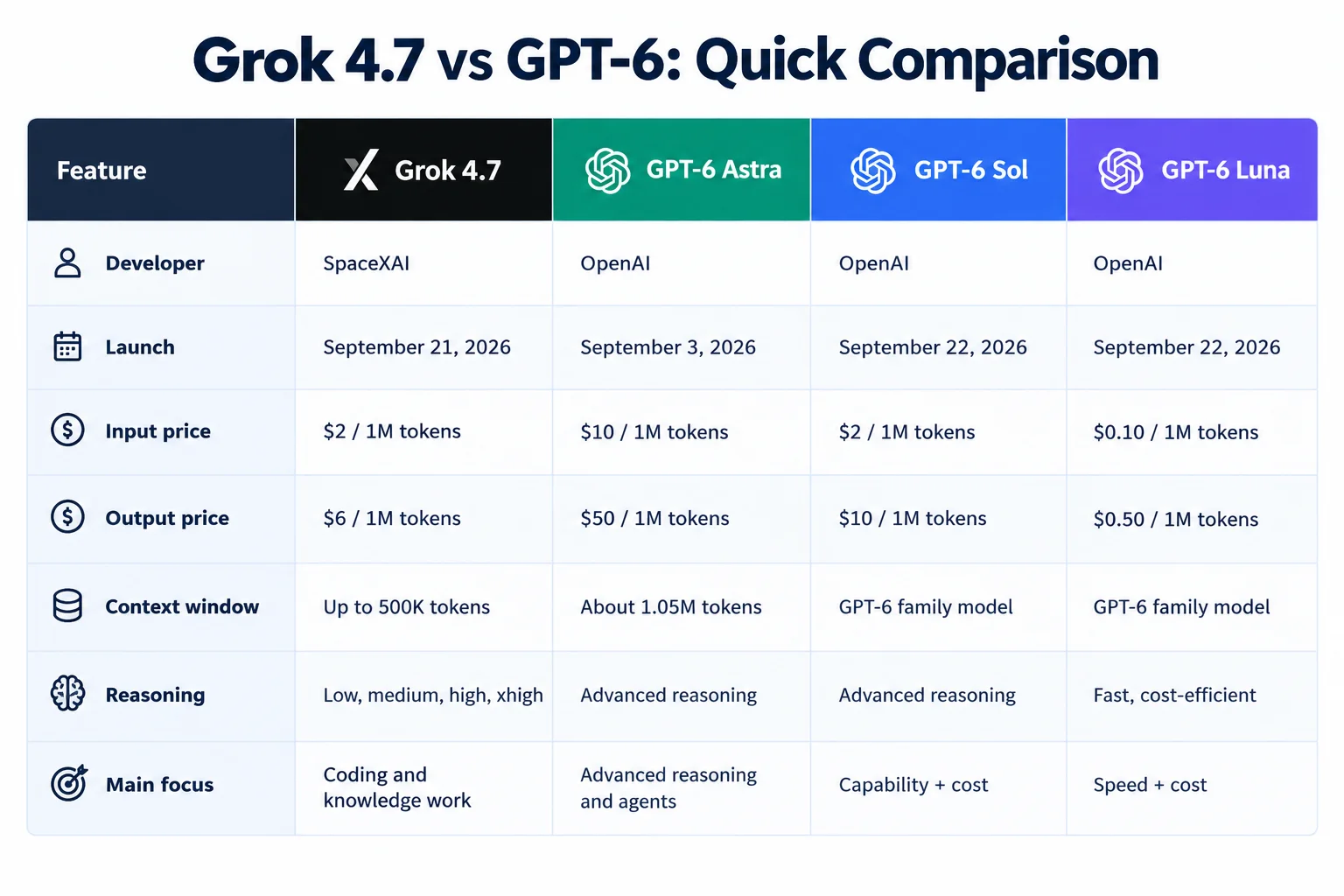
Pricing shown above is standard API pricing and can vary by context length, service tier, or provider. Grok 4.7's official API documentation lists a 500K context window and $2/$6 standard pricing, while OpenAI lists Astra at $10/$50, Sol at $2/$10, and Luna at $0.10/$0.50 per million tokens.
What is Grok 4.7?
Grok 4.7 is SpaceXAI's latest frontier model for coding, agentic tasks, and knowledge work.
SpaceXAI says the model was built on a larger base model than Grok 4.6 and trained with a longer reinforcement-learning run focused on difficult tasks that can take hours to complete.
One of the biggest themes of the release is self-verification. Grok 4.7 is designed to spend more time checking its work and managing longer-running tasks rather than simply producing an answer and stopping.
The model supports text and image inputs with text output, a context window of up to 500,000 tokens, and four reasoning-effort settings: low, medium, high, and xhigh.
Its standard API pricing is:
$2 per million input tokens
$0.50 per million cached input tokens
$6 per million output tokens
A faster variant is available at higher rates.
Grok 4.7 is available through the Grok API and is also integrated into products and coding environments including Cursor and Grok Build.
What is GPT-6 Astra?
GPT-6 Astra is OpenAI's flagship GPT-6 model.
OpenAI describes Astra as its most capable broadly deployed model, with a focus on computer use, browsing, software engineering, cybersecurity, science, and professional work.
It launched on September 3, 2026.
Astra is considerably more expensive than Grok 4.7 at standard API rates:
$10 per million input tokens
$1 per million cached input tokens
$50 per million output tokens
OpenAI also reports a roughly 1.05-million-token context window for Astra in current independent model tracking.
The important distinction is that Astra is not simply positioned as a chatbot model. OpenAI is targeting workflows in which an AI system can operate across software, browsers, codebases, and professional applications.
That makes the model particularly relevant for developers building autonomous or semi-autonomous agents.
GPT-6 Sol and Luna: the cheaper alternatives
The GPT-6 comparison becomes more interesting once Sol and Luna enter the picture.
OpenAI released both models on September 22, 2026.
GPT-6 Sol is designed as a lower-cost alternative to Astra, while GPT-6 Luna is positioned as the fastest and most cost-efficient member of the GPT-6 family.
Their standard API prices are dramatically lower than Astra:
GPT-6 Sol
$2 per million input tokens
$0.20 cached input
$10 per million output tokens
GPT-6 Luna
$0.10 per million input tokens
$0.01 cached input
$0.50 per million output tokens
That changes the practical comparison.
If you are asking “Grok 4.7 vs GPT-6 Astra,” price is a major difference.
If you're asking “Grok 4.7 vs GPT-6,” however, the answer is more complicated because GPT-6 now covers several price and performance levels.
Grok 4.7 vs GPT-6: Performance comparison
Coding
Coding is one of Grok 4.7's biggest selling points.
SpaceXAI reports a 46.3% score on CursorBench 4.0 at xhigh reasoning, up from 40.4% for Grok 4.6. The company also reports major improvements on longer-running software-engineering and terminal tasks.
But benchmark comparisons don't show Grok dominating every coding evaluation.
For example, Artificial Analysis currently reports GPT-6 Astra at 59% on Terminal-Bench 4.0, compared with 26% for Grok 4.7 at high reasoning in its comparison.
That suggests an important distinction:
Grok 4.7 is a very capable coding model, but benchmark results depend heavily on the task, model configuration, and evaluation methodology.
For everyday coding, repository work, debugging, and iterative development, either model can be highly capable. For complex autonomous software-engineering agents, Astra has stronger results on several currently available evaluations.
Agentic tasks
Agentic AI is where the comparison becomes especially interesting.
An agentic model doesn't simply answer a question. It may need to:
Understand a goal
Plan multiple steps
Use tools
Inspect the results
Correct mistakes
Continue working
Deliver a finished result
Grok 4.7 was explicitly trained around longer-running tasks. SpaceXAI says its reinforcement-learning training placed greater weight on problems requiring many hours of work.
GPT-6 Astra, meanwhile, was built heavily around computer use and multi-step professional workflows.
Independent evaluations currently show Astra ahead on several difficult agentic benchmarks, including Terminal-Bench and AutomationBench, although Grok 4.7 performs strongly on some professional-work evaluations.
So there isn't a useful single number that tells the entire story.
Knowledge work
Grok 4.7 isn't just a coding model.
SpaceXAI reports improvements on professional knowledge-work evaluations including AA Briefcase and GDPval, which test tasks involving documents, analysis, presentations, and other professional outputs.
In fact, SpaceXAI's own published comparison shows Grok 4.7 scoring strongly on AA Briefcase and GDPval relative to several other models.
However, these numbers should be interpreted carefully because benchmark setups, model settings, and evaluation procedures differ.
For real-world knowledge work, factors such as instruction following, context handling, tool access, output quality, and reliability can matter as much as a benchmark score.
Reasoning
GPT-6 Astra has a particularly strong case when the task requires difficult reasoning.
OpenAI reports state-of-the-art results for Astra across several demanding reasoning and scientific evaluations, including FrontierMath, ARC-AGI-3, and other professional and computer-use benchmarks.
Independent comparisons also currently place Astra ahead of Grok 4.7 on several reasoning-oriented evaluations.
That doesn't mean Grok 4.7 is weak at reasoning. Its high reasoning modes can spend substantially more computation on difficult problems.
The more useful takeaway is that Astra is aimed at the highest-end reasoning workloads, while Grok 4.7 places considerable emphasis on the combination of capability, speed, and cost.
Context window: Grok 4.7 vs GPT-6 Astra
Context length matters when you are working with:
Large codebases
Long documents
Research collections
Conversation histories
Large datasets
Multi-step agent workflows
Grok 4.7 supports up to 500,000 tokens of context.
GPT-6 Astra has a larger context window, currently documented at roughly 1.05 million tokens in independent model tracking.
So if your primary requirement is fitting extremely large amounts of information into one context, Astra has more headroom.
But context size alone doesn't determine how well a model uses that information. Retrieval quality, attention over long inputs, tool use, and the model's ability to reason over the material are also important.
Pricing: where Grok 4.7 gets interesting
This is probably the biggest practical advantage of Grok 4.7.
At standard API rates:
Grok 4.7: $2 input / $6 output
GPT-6 Astra: $10 input / $50 output
That makes Astra substantially more expensive on raw token pricing.
But there is an important catch.
The cheapest model isn't automatically the cheapest per completed task.
A model that uses more tokens, requires more retries, or needs additional tool calls can erase some of its apparent price advantage.
Independent analysis therefore looks at both token pricing and estimated cost per task rather than treating API pricing as the whole story.
For developers running thousands or millions of requests, however, the difference in published token rates can still be significant.
Safety and safeguards
Both companies have emphasized safety improvements with these releases.
SpaceXAI says Grok 4.7 uses a new safeguard stack and reports improvements in refusal behavior and jailbreak resistance. It also reports a 62.4% result on its cited LatchBio biosafety evaluation.
OpenAI has also made safety a major part of the GPT-6 Astra rollout.
OpenAI says Astra reached its Critical cybersecurity capability threshold under its Preparedness Framework and describes additional safeguards involving isolation, monitoring, and protections against harmful cyber actions.
These claims come primarily from the companies' own evaluations, so they should not be treated as directly interchangeable scores.
Grok 4.7 vs GPT-6: which should you use?
There isn't one model that makes sense for every workload.
Choose Grok 4.7 if you care about:
Competitive API pricing
Coding and software development
Long-running tasks
Knowledge-work workflows
Large-context applications
Using AI heavily at scale
Integration with tools such as Cursor
Its combination of capability and published token pricing makes it particularly interesting for developers who need strong performance without paying flagship-model prices.
Choose GPT-6 Astra if you need:
Advanced reasoning
Complex autonomous agents
Computer-use workflows
Scientific and mathematical workloads
Difficult professional tasks
The largest context window in this comparison
Astra is the model to look at when raw frontier capability matters more than API cost. OpenAI specifically positions it for demanding reasoning, coding, computer use, science, and professional work.
Choose GPT-6 Sol if you want:
GPT-6 capabilities at a lower price
A balance between capability and cost
Coding and professional workloads without Astra-level pricing
Sol sits much closer to Grok 4.7 on API input pricing, although its output price is higher.
Choose GPT-6 Luna if you need:
Very low-cost inference
High-volume workloads
Fast responses
Simpler or more focused tasks
At $0.10 per million input tokens and $0.50 per million output tokens, Luna occupies a completely different price tier from Astra.
The real answer to Grok 4.7 vs GPT-6
The late-2026 AI landscape isn't really a two-model race anymore.
It's becoming a model selection problem.
Grok 4.7 competes aggressively on coding, knowledge work, long-running tasks, and price. GPT-6 Astra targets the highest-end reasoning and agentic workloads. GPT-6 Sol brings much of the GPT-6 family to a lower price point, while Luna targets inexpensive, high-volume inference.
And the benchmark data reinforces that there isn't a single universal ranking.
A model can lead on one evaluation and trail on another. Grok 4.7, for example, performs strongly on several professional-work benchmarks while Astra currently has stronger results on multiple difficult reasoning and agentic evaluations.
For developers, that means the most useful question isn't simply:
“Which model is smarter?”
It's:
“Which model gives me the capability, speed, reliability, and cost profile my workload actually needs?”
For some teams, that answer will be Grok 4.7. For others, it will be Astra, Sol, or Luna.
And as the model race continues, that ability to choose the right model for the right job may matter more than having a single favorite AI model.