Replace Your Paid Software With This 9 Free GitHub Repos
Open-source alternatives to Semrush, Intercom, ElevenLabs, Notion AI, Loom, Wispr Flow, Asana, Calendly and Higgsfield, and what to check before you cancel
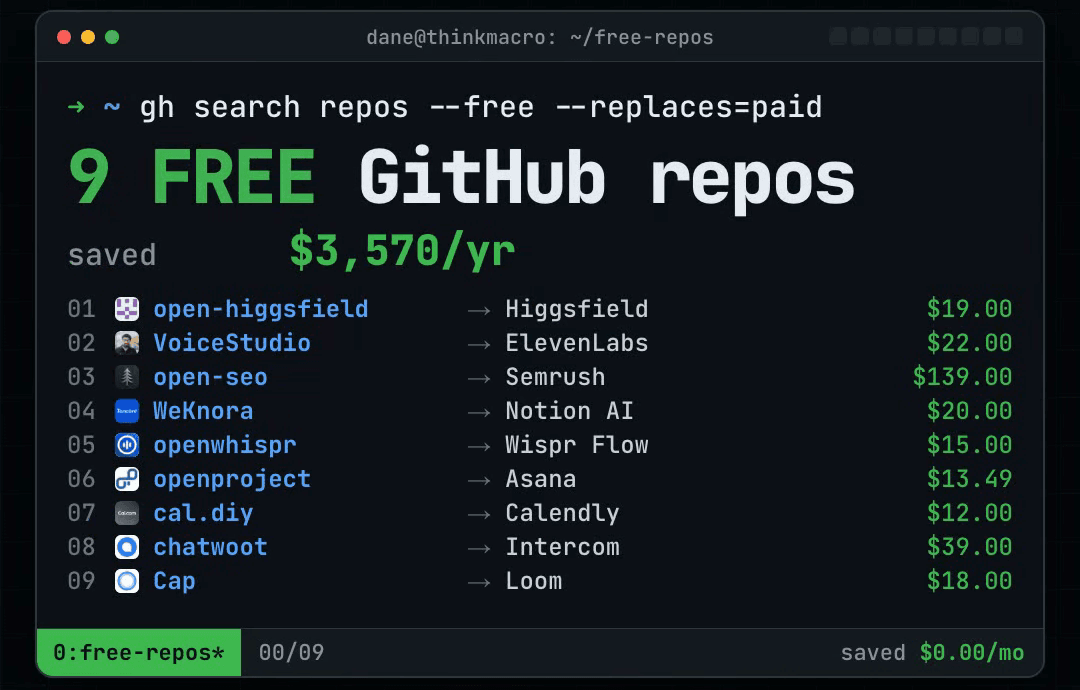
Nine free projects on GitHub can stand in for paid tools that together cost about $297 a month, or roughly $3,570 a year. They cover AI video, voice generation, SEO, AI knowledge bases, dictation, project management, scheduling, customer support and screen recording.
Subscriptions rarely hurt one at a time. A $12 scheduler here, a $39 support inbox there, and a year later you're paying rent to a dozen companies. The repos below are the open-source answer to that creep: you clone them, run them yourself, and keep the money.
Here is what each one does, what it replaces, and what to check before you cancel anything.
The nine at a glance
OpenSEO alone accounts for almost half the savings, because Semrush is the priciest tool on the list.
Free repo | Replaces | Paid plan you skip ($/mo) | License | GitHub stars |
|---|---|---|---|---|
Semrush | 139.00 | MIT | 25.3k | |
Intercom | 39.00 | MIT | 38.4k | |
ElevenLabs | 22.00 | AGPL-3.0 | 91.1k | |
Notion AI | 20.00 | MIT | 35.7k | |
Higgsfield | 19.00 | None yet | 4.8k | |
Loom | 18.00 | AGPL-3.0 | 23.9k | |
Wispr Flow | 15.00 | MIT | 10.1k | |
Asana | 13.49 | GPL-3.0 | 16.7k | |
Calendly | 12.00 | MIT | 49.4k | |
Total | 297.49 |
Prices are the entry-level monthly plans for one user. Check current pricing and your seat count before you count the savings as yours.
1. Open Higgsfield replaces Higgsfield
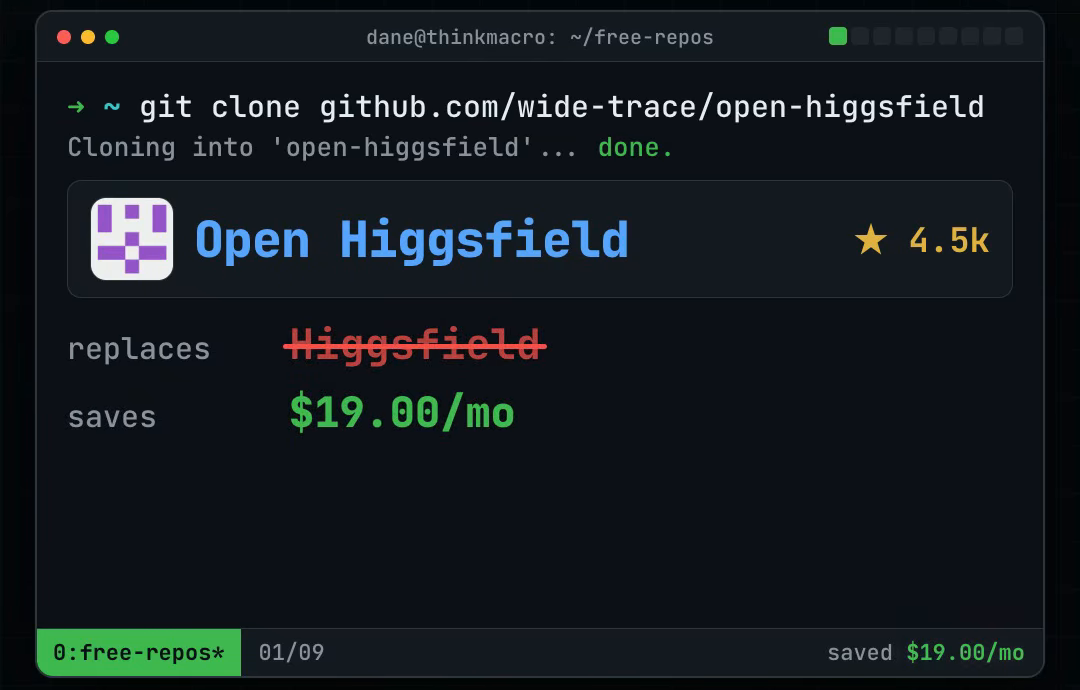
Open Higgsfield is a web studio for AI image and video generation. You get one prompt bar, 38 models (8 for images, 30 for video), each model's own settings, and a gallery of every finished run. Run it locally with pnpm dev, or use the hosted version.
The catch: you bring your own API key for a generation platform, so you still pay for each generation. You drop the subscription, not the compute bill. The repo also has no license file yet, so legally it isn't open source. Don't build a business on it without asking the author.
2. VoiceStudio replaces ElevenLabs
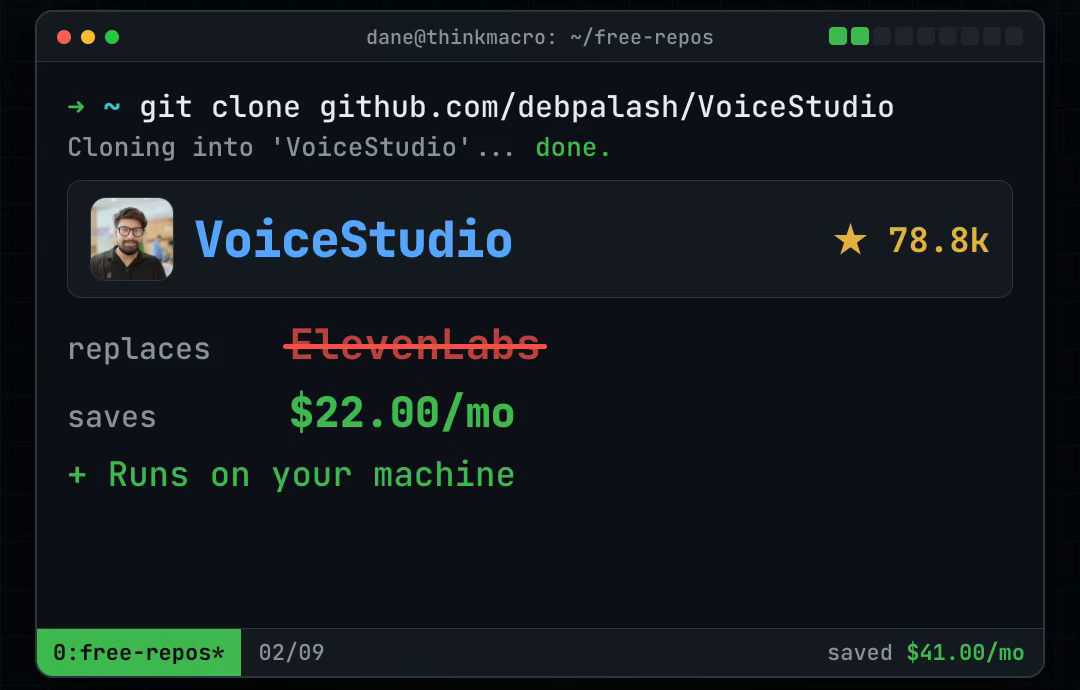
VoiceStudio is a fully local ElevenLabs alternative. It does voice cloning, voice design, video dubbing, dictation, transcription and audiobook creation in 646 languages, and your audio never leaves your computer.
It ships as a desktop app. It's fastest on an NVIDIA GPU or Apple silicon, and still works on CPU alone, just slower, with about 5 GB of disk for models.
3. OpenSEO replaces Semrush
OpenSEO is the biggest saving on the list. It covers keyword research, rank tracking, backlink analysis, site audits, competitor insights and AI-search visibility. It even has an MCP server, so AI agents can query your SEO data. You self-host it with Docker or on Cloudflare.
The catch: the SEO data comes from the DataForSEO API, which you pay for per use. That's much cheaper than a flat $139 if you run occasional checks. If you track thousands of keywords daily, estimate the API cost first.
4. WeKnora replaces Notion AI
WeKnora, from Tencent, turns your documents into a knowledge base you can ask questions of. It also runs AI agents over your files and keeps wikis up to date on its own. It runs on local models through Ollama, or connects to 29 hosted model providers. Deploy it with Docker Compose, Kubernetes, or a lightweight single-binary "Lite" version.
To be fair to Notion: WeKnora replaces the "ask AI about my docs" part of Notion AI, not Notion's editor.
5. OpenWhispr replaces Wispr Flow
OpenWhispr lets you dictate into any app on macOS, Windows or Linux. Use cloud models when you're online, or local speech models like Whisper and NVIDIA Parakeet when you want everything to stay on your device. It also transcribes meetings and takes notes.
6. OpenProject replaces Asana
OpenProject is the "Asana killer" of the list. It's a mature project management suite with tasks, agile boards, Gantt charts, roadmaps and issue tracking. The self-hosted Community edition is free. A paid Enterprise edition adds support and extra features if you outgrow it.
7. Cal.diy replaces Calendly
The video calls this one Cal.com, but the repo it clones is Cal.diy. That's the community edition of Cal.com with all the enterprise code removed, 100% MIT-licensed. You get booking pages and calendar sync with Google and Outlook, self-hosted only. If you'd rather not run a server, Cal.com itself has a free hosted tier.
8. Chatwoot replaces Intercom
Chatwoot puts every lead and client message in one inbox. It covers website live chat, email, WhatsApp, Facebook, Instagram, Telegram, SMS and more, so your team answers everything from one screen. Self-hosting is free under the MIT license.
9. Cap replaces Loom
Cap records your screen on macOS or Windows, lets you edit locally, and gives you an instant share link. You choose where recordings live: Cap's cloud, your own S3 bucket, or a fully self-hosted server. A paid Cap Pro plan exists if you want them to host it.
The math
You don't need all nine to feel it. Swap out just five (Semrush, Intercom, Loom, Asana and Calendly) and $221.49 a month comes back to you. That's about $2,658 a year from five cancellations.
Replace all nine and the monthly bill drops by $297.49, or about $3,570 a year. For a solo founder or a small team, that's a new laptop, a conference ticket, or a few months of runway. Take a little off for Open Higgsfield and OpenSEO, which swap a subscription for pay-as-you-go API costs.
Per-seat pricing makes the gap wider. Asana, Intercom and Loom all charge per user, so a five-person team pays several times the single-seat numbers above. The open-source versions don't care how many people log in.
Bonus: what if your app isn't on the list?
The video closes with a tenth repo for everything else: Reverse Engineer Anything (REA). The pitch is that you point Claude Code at it, ask it to rebuild your favorite app, and it does.

The reality is more modest, and more useful. REA is an MCP server that gives coding agents like Claude Code, Codex and Cursor reverse-engineering tools. They can inspect native binaries, Electron apps, .NET assemblies, Android APKs and firmware, and get back pseudocode, assembly and module maps. That helps you understand how an app works so you can build your own version. It's not a one-click clone.
Mind the legal line, too. REA's own docs limit it to research, education, interoperability, and software you own or are authorized to examine. Copying a commercial app can break its license.
Before you cancel anything
Free code is not the same as free to run. Open source moves the cost from a monthly invoice to your own time and hardware, so be honest about these before you switch:
Hosting. VoiceStudio, OpenWhispr and Cap run on your own computer at no extra cost. Chatwoot, OpenProject, Cal.diy, WeKnora and OpenSEO need a server, usually $5 to $20 a month on a small cloud machine.
Hardware. Local AI tools for voice, video and document chat run best on a recent GPU or Apple silicon. On an older laptop they can be slow.
Setup and upkeep. Someone has to install updates, take backups and fix things when they break. If that someone is you, count your hours.
Feature gaps. The paid tools often have polish, integrations and support that the open versions lack. Run the free one next to the paid one for a week before you cancel.
Licenses. VoiceStudio and Cap are AGPL-3.0 and OpenProject is GPL-3.0. That's fine for internal use, but read the license before you build a paid product on top of one. Open Higgsfield has no license yet.
A good rule: start with the most expensive line on your bill, and keep paying wherever the paid version saves you real time.
Pick one and try it this week
Don't migrate your whole stack in a weekend. Open your bank statement, find the subscription that stings most, and test its free twin from the list above for a week. If it holds up, cancel. If it doesn't, you've lost nothing but an afternoon.
Which paid tool would you replace first? Tell me in the comments.
This roundup is based on a short video by think_macro_