Spark-X2.6-4B: A Powerful 4B AI Model for Local Agents, Coding, and Long-Context Tasks
Unleash Spark-X2.6-4B: a compact, open-weight AI model with 1M token context for local coding, agents & powerful reasoning. Get started now!
Spark-X2.6-4B is a compact open-weight AI model designed to bring stronger reasoning, coding, and agentic capabilities to local and resource-conscious deployments. Developed by XHToken, it builds on Spark-X2.5-4B with improved post-training rather than a completely new architecture.
The result is a model that aims to handle complex tool interactions, software engineering tasks, multi-step planning, and large amounts of text while retaining the practical advantages of a model with approximately 4 billion parameters.
One of its most notable features is a claimed context window of up to 1,048,576 tokens, alongside configurable reasoning modes that let developers balance response quality against latency and computational cost.
Released under the Apache 2.0 license, Spark-X2.6-4B is worth exploring for developers building local AI assistants, coding tools, research workflows, and on-device agents.
Get the model: Download Spark-X2.6-4B on Hugging Face
What Is Spark-X2.6-4B?
Spark-X2.6-4B is a general-purpose, open-weight language model from the Spark model series. Its primary goal is to improve what compact AI models can accomplish without requiring the hardware typically associated with much larger language models.
Rather than introducing a fundamentally different architecture, XHToken says Spark-X2.6-4B retains the architecture of its predecessor, Spark-X2.5-4B, with capability improvements coming primarily from refined post-training.
This approach is particularly relevant to AI agents. An agent needs to do more than generate fluent text. It may need to understand a task, plan several steps, call external tools, inspect results, write or modify code, and adjust its approach when something goes wrong.
Smaller models can struggle with these multi-stage workflows. Spark-X2.6-4B is designed to improve performance in precisely these areas.
According to the developer's published evaluations, the model can compete with certain larger models on selected coding and agent benchmarks. These results are promising, although they should be interpreted in the context of benchmark methodology, inference settings, and the fact that many headline comparisons originate from the model developer.
Key Features of Spark-X2.6-4B
1. A Context Window of Up to One Million Tokens
One of the most attention-grabbing specifications is the model's advertised context window of up to 1,048,576 tokens.
A large context window can help applications work with extensive documentation, lengthy source-code repositories, multiple research papers, and long conversation histories without immediately splitting the material into smaller chunks.
For example, a developer could use a long-context model to examine several related source files, trace dependencies, or investigate how different components of a software project interact.
Researchers could also use it to analyse collections of documents, compare lengthy reports, or search for relationships across large bodies of text.
However, a million-token context window is a supported capability, not a guarantee that every computer can process one million tokens efficiently. Memory requirements, key-value cache size, runtime support, and inference speed all matter. Developers should test their intended context lengths on their actual hardware.
2. Configurable Thinking Modes
Spark-X2.6-4B introduces three reasoning or thinking settings:
None: For applications that prioritise low latency and straightforward responses.
Low: For tasks that benefit from some additional reasoning without always requiring the deepest processing.
High: For more demanding tasks involving planning, coding, complex instructions, or multi-step problem-solving.
This flexibility can be useful when building AI-powered applications. A simple classification request may not require the same reasoning budget as a complicated software debugging task.
Developers can therefore experiment with different settings for different workloads instead of applying the most computationally expensive mode to every request.
Actual latency and output quality will depend on the prompt, runtime, hardware, and task being performed.
3. Improved Coding and Software Engineering
Coding is one of the model's major target areas.
Spark-X2.6-4B is designed to assist with code generation, debugging, repository-level analysis, and software engineering workflows. Its improvements are particularly relevant to agentic coding tools, where a model must interpret requirements, use tools, inspect results, and make changes across multiple steps.
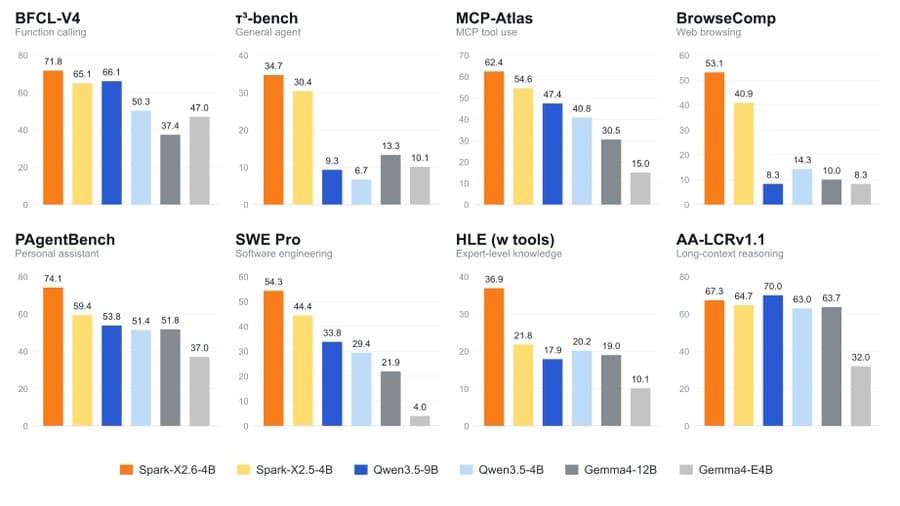
The developer reports a score of 54.3 on SWE-bench Pro and 62.8 on SWE-bench Verified under its published high-thinking evaluation settings.
These scores suggest that the model is worth testing in coding workflows, particularly where a smaller local model could reduce dependence on remote inference services.
Nevertheless, benchmark scores do not automatically translate into reliable performance on every programming language, framework, or real-world repository. Developers should evaluate the model against their own codebases and use automated tests, code review, and appropriate security checks.
4. Stronger Tool Use and Agentic Workflows
Traditional chatbots primarily respond to user prompts. Agentic systems, by contrast, may need to select tools, call functions, interpret tool outputs, and continue working until a task is completed.
Spark-X2.6-4B targets this more demanding category of AI applications.
The developer reports the following results under high-thinking settings:
BFCL-V4: 71.8 — a benchmark associated with function-calling capabilities.
MCP-Atlas: 62.4 — an evaluation focused on tool-use workflows.
BrowseComp: 53.1 — a benchmark associated with challenging information-retrieval and browsing tasks.
SWE-bench Pro: 54.3 — a software engineering benchmark.
These results are developer-reported figures, not a guarantee of equivalent performance in every deployment. Benchmark versions, scoring methods, model configurations, and tool environments can affect comparisons.
Even with that qualification, the emphasis on tool use makes Spark-X2.6-4B relevant to developers experimenting with local research agents, coding assistants, and task-automation systems.
5. A Compact Model with Multiple Quantization Options
A model's parameter count is only part of the hardware equation. Weight precision, context length, runtime overhead, and memory used during inference also influence whether it can run comfortably on a particular machine.
Spark-X2.6-4B offers multiple model formats and quantized checkpoints, including GGUF and lower-precision variants.
Quantization reduces the precision used to represent model weights, potentially lowering memory requirements and improving accessibility on consumer hardware. The trade-off is that quality and performance can vary depending on the quantization method and workload.
For developers using a local inference engine, a quantized checkpoint may be more practical than the full-precision model. The best choice depends on available RAM or VRAM, desired response speed, and acceptable quality loss.
Spark-X2.6-4B Benchmark Performance
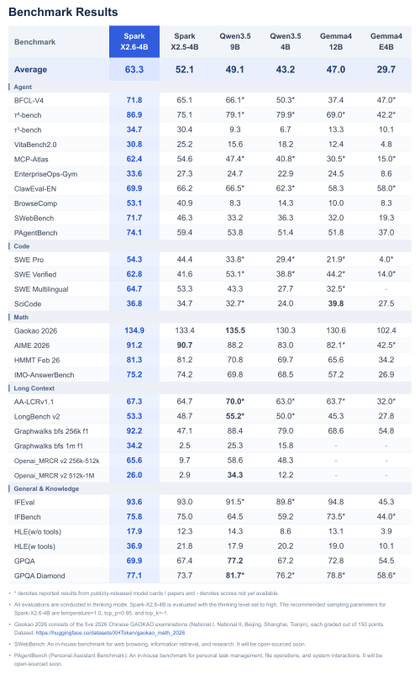
The developer reports an average score of 63.3 across its published evaluation suite for Spark-X2.6-4B, compared with 52.1 for Spark-X2.5-4B, 49.1 for Qwen3.5-9B, and 43.2 for Qwen3.5-4B in the cited comparison.
These figures are useful as an indication of the progress claimed by the Spark team, but they should not be treated as a universal ranking of AI models. An average across different benchmarks depends on which tests are included, how results are normalised, and whether competing models were evaluated under equivalent conditions.
Some comparison results may also be taken from other models' published reports rather than reproduced under a single, identical testing setup.
For that reason, it is more useful to examine individual benchmark categories alongside the aggregate score.
Agentic Performance
Function calling and tool-use benchmarks help evaluate whether a model can select actions and work with structured interfaces. Spark-X2.6-4B's reported BFCL-V4 and MCP-Atlas results make these important areas to investigate when testing it for agent-based applications.
Software Engineering
The reported SWE-bench Pro and SWE-bench Verified scores indicate that coding is a central part of the model's intended use. Real-world testing should still establish how well it handles unfamiliar repositories, complex bug reports, test generation, and multi-file changes.
Long-Context Reasoning
The model's advertised context window is a significant part of its positioning. However, accepting a long prompt is not the same as accurately retrieving every relevant detail from it.
For long-context applications, developers should test information retrieval, multi-document synthesis, and consistency across different context lengths rather than relying on the maximum-token specification alone.
How Does It Compare with Larger Models?
The Spark team positions the 4B model as competitive with, and in selected evaluations capable of matching or surpassing, some models in the 9B parameter range.
This is a potentially valuable result because smaller models can offer lower weight-memory requirements and may be easier to deploy on local systems.
However, a 4B model will not necessarily outperform a 9B model across every task. Results vary with the benchmark, reasoning settings, quantization, inference engine, and hardware. Users should compare the specific models and tasks that matter to their projects.
Architecture: How Spark-X2.6-4B Balances Efficiency and Context
Spark-X2.6-4B inherits the hybrid attention design described for Spark-X2.5-4B.
In broad terms, hybrid attention combines layers that focus on a limited local window with layers that can attend across a wider portion of the sequence. The aim is to reduce the computational burden of processing long inputs while retaining access to broader context.
The architecture described in the model's technical materials uses a repeating pattern of sliding-window attention and full-attention layers. This approach can make long-context processing more practical than relying exclusively on full attention at every layer.
Still, the model's architecture does not eliminate the cost of long-context inference. Runtime implementation, attention-cache management, available memory, and input length continue to affect resource consumption.
For developers, the practical takeaway is straightforward: Spark-X2.6-4B combines a compact model size with an architecture intended to support long-context workloads, but deployment settings must be chosen carefully.
How to Run Spark-X2.6-4B Locally
Spark-X2.6-4B supports several deployment paths, including Hugging Face Transformers, vLLM, SGLang, llama.cpp, Ollama, and LM Studio. Compatibility and setup requirements can differ between versions, so consult the official instructions before installing.
Option 1: Run It with Ollama
Ollama provides a convenient way to experiment with local language models without manually building an inference server.
First, install Ollama from its official website:
Then run the model using the command listed in the official Spark repository:
ollama run SparkLLM/Spark-X2.6-4BOnce the model is available locally, you can interact with it from the terminal and explore its capabilities.
For the latest model tag, hardware guidance, and runtime requirements, check the official Spark-X2.6 GitHub repository.
Option 2: Use Hugging Face Transformers
Developers who want to integrate the model into Python applications can start with the official Hugging Face checkpoint.
Install the required Transformers version specified by the repository:
pip install transformers==4.57.1A basic loading example is:
from transformers import AutoModelForCausalLM, AutoTokenizer

model_id = "XHToken/Spark-X2.6-4B"

tokenizer = AutoTokenizer.from_pretrained(model_id)

model = AutoModelForCausalLM.from_pretrained(
    model_id,
    trust_remote_code=True,
    torch_dtype="auto",
    device_map="auto",
)
This loads the tokenizer and model using automatic device placement. It is a starting point rather than a complete text-generation application; you still need to format messages using the model's chat template, prepare inputs, generate a response, and decode the output.
Security note: trust_remote_code=True allows custom code supplied with the model repository to execute. Review the repository and its code before enabling this option, particularly in production or sensitive environments.
Follow the official Hugging Face model card for the complete inference example and configuration guidance.
Option 3: Deploy an API Server with vLLM
Developers building applications that need a local model endpoint can use vLLM, which supports OpenAI-compatible API interfaces.
The official Spark repository provides deployment examples for serving the model. These can be adapted for applications that send chat-completion requests to a local server.
Start with the Spark-X2.6 GitHub deployment guide and follow the instructions for the appropriate GPU or accelerator.
Before exposing the endpoint to other machines, configure authentication, network access, and other security controls appropriate to your environment. An API-compatible interface does not automatically make a server secure.
Option 4: Use llama.cpp or LM Studio
For users interested in quantized models and desktop-oriented local inference, llama.cpp and LM Studio are other options.
llama.cpp: Useful for running supported model formats from the command line or through a local server.
LM Studio: Provides a graphical interface for discovering, downloading, and running supported models.
Ollama: Offers a simple command-line workflow and local model management.
Check the official repository for the required versions and supported formats. Compatibility can change as inference engines add or update model support.
Hardware Requirements: Can It Run on a Regular Computer?
Spark-X2.6-4B's relatively small parameter count makes it more accessible than many larger language models, especially when quantized weights are available.
However, there is no single hardware requirement that applies to every setup.
The amount of memory you need depends on the checkpoint precision, quantization, context length, batch size, inference engine, and other processes running on your computer.
A few practical guidelines:
Limited-memory systems: Start with a supported quantized checkpoint and a shorter context length.
Consumer NVIDIA GPUs: Check available VRAM and the runtime's memory requirements before selecting a model format.
Apple silicon Macs: Review the current MLX or other supported runtime instructions for your device.
Long-context workloads: Increase context length gradually while monitoring memory use and response speed.
Production deployments: Benchmark the actual workload, including concurrent users and longer prompts, rather than testing only short conversations.
A model advertised with a one-million-token context window may still require substantial memory and compute to use that full window. For many everyday tasks, a much smaller context will be faster and more economical.
Best Use Cases for Spark-X2.6-4B
Local Coding Assistants
Developers can evaluate the model for code completion, debugging support, test generation, and repository analysis. Its agent-oriented focus may also be useful in systems that allow a model to invoke development tools.
Private Document Analysis
Running a model locally can help organisations keep document processing within their own infrastructure. This may be attractive for internal reports, technical documentation, and sensitive business materials.
Local inference does not by itself guarantee privacy, however. Applications should also consider logs, stored prompts, telemetry, access controls, and the security of the surrounding system.
Research and Long-Document Workflows
The long-context capability makes the model worth testing for research assistants that need to inspect extensive documentation or compare multiple documents. Retrieval quality and factual consistency should be evaluated before relying on it for important conclusions.
Personal AI Agents
The model's focus on function calling, planning, and tool use makes it a candidate for local assistants that interact with calendars, files, APIs, or other applications. Tool permissions should be restricted to the actions the agent genuinely needs.
Offline and Edge Applications
Where connectivity is unreliable or cloud inference is undesirable, a local model may offer operational advantages. Whether Spark-X2.6-4B is suitable depends on the target device, response-time requirements, and the complexity of the tasks.
Limitations to Consider Before Using It
Despite its promising specifications, Spark-X2.6-4B is not a universal replacement for larger or hosted models.
Benchmark results require context. The headline scores are primarily developer-reported. Independent testing and consistent comparisons can help establish how the model performs across different tasks.
Long context costs resources. A million-token context window does not mean million-token inference is inexpensive or practical on every device.
Quantization involves trade-offs. Smaller checkpoints may reduce memory usage, but output quality and speed depend on the chosen format and runtime.
Agentic tasks need safeguards. A model can make incorrect tool calls, misunderstand instructions, or produce flawed code. Use permission boundaries, validation, and human oversight for consequential actions.
Runtime compatibility matters. Some deployment paths may require specific versions, custom model code, or particular configuration settings. Verify the latest official documentation before building a production workflow.
These limitations do not make the model less interesting. They simply mean that the best way to evaluate it is through realistic testing rather than specifications alone.
Where to Download Spark-X2.6-4B
The official model and supporting resources are available through these links:
Hugging Face model: https://huggingface.co/XHToken/Spark-X2.6-4B
Official GitHub repository: https://github.com/XHToken/Spark-X2.6
Official model collection: https://huggingface.co/collections/XHToken/spark-x26
Ollama model page: https://ollama.com/SparkLLM/Spark-X2.6-4B
MLX deployment project: https://github.com/XHToken/Spark-MLX-LLM
The Hugging Face page is the best starting point for the model card and checkpoint details, while the GitHub repository provides deployment instructions and technical examples.
Final Verdict: Is Spark-X2.6-4B Worth Trying?
Spark-X2.6-4B is an interesting release for developers who want a compact open-weight model with an emphasis on agentic workflows, coding, tool use, and long-context reasoning.
Its combination of approximately 4 billion parameters, configurable thinking modes, multiple deployment options, and an advertised context window of up to one million tokens gives developers several reasons to experiment with it.
The most compelling aspect is not simply the model's size. It is the attempt to make a smaller model more useful for practical tasks that involve planning, tool interaction, and multi-step execution.
The reported benchmark improvements are encouraging, but developers should validate them against their own workloads and hardware. For local coding assistants, privacy-conscious applications, and experimental AI agents, Spark-X2.6-4B is a promising model to add to the evaluation list.
Ready to try it? Start with the official Spark-X2.6-4B model on Hugging Face and use the GitHub repository to choose a suitable deployment method.
Frequently Asked Questions
What is Spark-X2.6-4B?
Spark-X2.6-4B is an approximately 4-billion-parameter open-weight language model developed by XHToken for coding, agentic workflows, reasoning, and long-context applications.
Is Spark-X2.6-4B free to use?
The model is released under the Apache 2.0 license. Review the license and applicable terms before incorporating it into a commercial product.
Does Spark-X2.6-4B support a one-million-token context window?
The developer advertises a maximum context length of 1,048,576 tokens. Using that maximum in practice depends on runtime support, configuration, available memory, and workload.
Can I run Spark-X2.6-4B locally?
Yes. The project documents deployment options including Transformers, vLLM, SGLang, llama.cpp, Ollama, and LM Studio. Requirements vary by runtime and model format.
Is Spark-X2.6-4B better than a 9B model?
The developer reports that Spark-X2.6-4B matches or exceeds certain larger models on selected benchmarks. That does not establish universal superiority; compare models on the specific tasks and settings that matter to you.
What is the best way to get started?
Visit the official Hugging Face model page, review the model card, and follow the setup instructions for your preferred inference engine.